
Measuring Unreachability: Factors Contributing to Call Disconnections and Call Blocking
By Magalie Senaux, statistical methodology expert, and Fabienne Le Sager, Director of the Statistics Statistics Statistics or Data Science is a field of mathematics that studies phenomena through data collection, processing, analysis, graphical representation and visualisation (Data Visualisation), as well as the interpretation of results. Find out more Department - Médiamétrie
14th Francophone Conference on Surveys, May 19–22, 2026, Vannes

Abstract
Telephone contactability has been sharply declining in recent years. A phenomenon driven by the progressive disappearance of landlines, the intensification of unsolicited calls, and the widespread adoption of call-screening technologies—now increasingly powered by AI. The introduction of Verified Multipurpose Numbers (VMN or NPV in french) in 2023 has made
survey
survey
A statistical method that aims to produce information about a population by interviewing part of the population (sample). This word is generally used to mean a survey conducted on a sample that have been interviewed using a questionnaire or else systematically observed.
Find out more
institutes explicitly identifiable but has not improved public perception: most unknown numbers continue to be associated with spam or fraudulent phone calls. This environment leads to heterogeneous patterns of nonresponse across demographic groups. Young adults and lower-socioeconomic groups were the first to become difficult to
reach
reach
Reach is the term used to describe the reach achieved by a medium, publication, advertisement or campaign. It corresponds to the number of users reached and is therefore quantitative data. Reach plays a key role in measuring return on investment. It is used to determine whether or not the communication is effective. Whether for a website or a social network, reach corresponds to the proportion of the Internet user population or the audience reached by the site or network over a set period.
Find out more
, a trend that has recently extended to women, while older respondents (65-year-old or more) are more likely to answer but also more likely to cut short the interview. Despite these operational signals, little empirical evidence exists on the mechanisms that shape individuals’ response propensity when receiving a call from an unknown number. To betterunderstand these behaviors, we conducted a one-time online survey on individuals equipped with a landline and/or mobile phone. The
study
study
Any research done across a population, line of business, or products (programme content, programme schedules, etc.) A study relies most often on the data coming out of a survey (or surveys).
Find out more
analyses motivations to answer or ignore calls, protective strategies against unsolicited calls, and factors influencing the decision to pick up the phone.
The findings reveal distinct behavioral profiles, highlight the growing influence of technical filters and user-initiated blocking practices, and offer new insights into the factors of contactability in modern telephone surveys. These insights pave the way for operational recommendations to optimise multimode designs and improve the effectiveness of telephone-initiated
data
data
Digital data
Find out more
collection.
1. Background
For several years now, telephone reachability has been a major vulnerability for survey survey A statistical method that aims to produce information about a population by interviewing part of the population (sample). This word is generally used to mean a survey conducted on a sample that have been interviewed using a questionnaire or else systematically observed. Find out more systems, simultaneously affecting the representativeness of samples, production costs, and the operational stability of fieldwork. The findings from our various survey programs are consistent: call drop rates continue their structural decline, reaching historically low levels, while refusals and “calls answered but hung up” (without the opportunity to explain the purpose of our call) are steadily increasing.
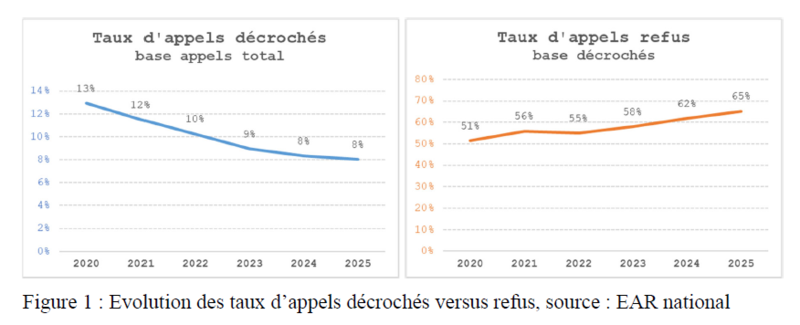
This trend has intensified further since January 1, 2023, when
ARCEP
ARCEP
The Autorité de Régulation des Communications Électroniques et des Postes (Electronic and postal communications regulator) is an independent administrative authority that was created on 5 January 1997 as the ART – Autorité de Régulation des Télécommunications (Telecoms Regulatory Authority). ARCEP is the architect and guardian of exchange networks in France. It ensures that the market is open to new players and to all forms of innovation. ARCEP works alongside the public authorities to extend connectivity right across France and runs the framework for network interoperability.
Find out more
implemented Verified Multipurpose Numbers (NPV), after which
survey
survey
A statistical method that aims to produce information about a population by interviewing part of the population (sample). This word is generally used to mean a survey conducted on a sample that have been interviewed using a questionnaire or else systematically observed.
Find out more
organizations became explicitly identifiable by their prefixes. This regulatory change has reinforced the public’s perception of survey calls as unwanted calls, especially as operator and manufacturer filtering systems (spam detection, automatic blocking, anti-fraud AI) have simultaneously become widespread. In addition to these technical constraints, there have been profound changes in devices and usage patterns:
A decline in the number of landline phones,
Differences in behavior based on age, social class, and occupational category,
Increased selectivity toward unrecognized numbers, and a proliferation of protection strategies (letting the phone ring, behavioral filtering, blocking).
Toward the Gradual Disappearance of the Landline
The results of our study study Any research done across a population, line of business, or products (programme content, programme schedules, etc.) A study relies most often on the data coming out of a survey (or surveys). Find out more “Equipment Barometer Barometer By analogy with meteorology, this term designates any regular measurement that can give an account of changes in audience, opinion, image, etc. Find out more 1” show, in particular, that households reachable via geographic numbers are now in the minority: in fact, while we estimate that two-thirds of French households have a landline number (starting with 01 through 05 or 09), only 44% of households have a physical phone associated with a landline number. Conversely, smartphone ownership has now become widespread across all Générations, meaning that the majority of individuals aged 13 and older can now be reached on their smartphones: 98.5% of them own a cell phone.
Uneven decline in call drop rates
Observations from our systems reveal that this decline does not affect different sociodemographic groups uniformly. The first signs of this trend emerged about ten years ago among the “Working Population Population The universe of a survey composed of basic statistical units. These units may be physical persons, households, companies, municipalities, etc. The population serves as a sampling frame for selecting a sample, and as a basis for calculation of the extrapolations from the sample. Find out more (Lower SPG Categories SPG Categories The SPG (socio-professional category), was replaced in 1982 by the classification of Professions and Socio-professional Categories (PCS), a nomenclature defined by France’s INSEE, which classifies the population according to a combination of profession (or former profession), hierarchical position and status (employee or otherwise). Find out more )” target target A subset of the population which we aim to reach with a show or advertising campaign. The target is defined using socio-demographic, equipment, or behavioural characteristics. Find out more group, for whom it has become progressively more difficult to get them to hang up. Subsequently, these challenges spread to the “Youth” target segment, where daily call volumes became increasingly difficult to meet despite careful Quota Quota The share allocated to a category of individuals when forming a sample. Find out more management. For about four years now, this phenomenon has also been affecting women under 50, for whom dropout rates have been deteriorating month after month, revealing an increasingly pronounced and concerning trend. At the same time, while people aged 65 and older remain among the most likely to drop out, they are significantly more likely to abandon the interview midway than younger individuals, which undermines the ability to maintain the rate of completed interviews.
Changes in behavior toward unknown numbers: selectivity and filtering
Another factor—one that is more difficult to quantify but has now become a key determinant—relates to changing behaviors regarding unknown numbers2, driven by an environment in which user protection has become a widely publicized issue. Public
awareness
awareness
Knowledge that a format (TV network, radio station, magazine), show, host, or brand exists. Spontaneous recall (in response to an open-ended question) is distinguished from aided recall (in response to a closed-ended question).
Find out more
campaigns—whether launched by government agencies, nonprofit organizations, or telecom providers—strongly encourage people not to answer unrecognized calls to avoid scams, identity theft, or aggressive telemarketing. At the same time, smartphone manufacturers have significantly enhanced automatic filtering features (spam detection, “silence unknown calls”
Mode
Mode
In statistics, the mode is the most common value.
Find out more
, number categorization, behavioral alerts), while telephone carriers are deploying their own blocking and scoring systems before connecting calls. Since 2024, these mechanisms have intensified further due to the widespread adoption of AI, which now enables dynamic, context-aware, and significantly more effective filtering. This combination—public advisories urging caution, stricter regulations, the technical sophistication of filters, and the rise of AI, contributes to growing selectivity
on the part of users, making effective access to respondents both more uncertain and more varied depending on the population and the device. Taken together, these findings point to a clear conclusion: while the challenges of reachability
are increasing and evolving, we still have little insight into the specific mechanisms that lead individuals to not answer the phone. In other words, we know who is less likely to answer, but we still do not know why these selective and filtering behaviors occur, nor how they vary according to user profiles and contexts of use.
These questions arise in an environment where excessive telephone solicitation and the rise in unwanted calls play a central role: ARCEP’s Customer
Satisfaction
Satisfaction
An area of study into consumer behaviour that aims to define the satisfaction or appreciation experienced by the user of a good, a product, or a service. Two complementary approaches are distinguished: understanding the process of forming satisfaction on one hand, and measuring the satisfaction on the other.
Find out more
Observatory shows that more than 70% of users report receiving fraudulent or unwanted calls on their cell phones every week, and that a majority of them say they do not answer calls from unknown numbers, or even systematically block such calls (ARCEP Observatory—sections on “unsolicited telemarketing” and “use of blocking tools”). These
data
data
Digital data
Find out more
thus align with the trends observed in our systems: in a context of heightened vigilance, strategies such as protection, blocking, systematically looking up the number, and filtering—whether built-in or via apps—have become an integral part of user behavior. To shed light on these gray areas and better understand users’ reactions to calls from unidentified numbers, we conducted a dedicated survey in December 2025 among individuals with a landline and/or cell phone. The insights gained will help shed light on current trends and identify ways to improve the
reach
reach
Reach is the term used to describe the reach achieved by a medium, publication, advertisement or campaign. It corresponds to the number of users reached and is therefore quantitative data. Reach plays a key role in measuring return on investment. It is used to determine whether or not the communication is effective. Whether for a website or a social network, reach corresponds to the proportion of the Internet user population or the audience reached by the site or network over a set period.
Find out more
of our telephone surveys (multimode surveys with initial
contact
contact
In media planning, a contact refers to an individual's exposure to an advertisement. In radio parlance, this is Opportunity to Hear (OTH) and for TV, Internet, press, cinema and poster advertisements, it is called Opportunity to See (OTS).
Find out more
by phone).
1 The Equipment Barometer is Médiamétrie’s benchmark study that describes all multimedia devices in French households (TV, cell phone, computer, Internet, game consoles, telephone, etc.)
2 An “unknown number” is a number the person does not recognize (numbers the person does not have in their contact list or does not recognize)
2. Survey Overview
This is an online survey lasting approximately 5 minutes, conducted among 3,016 respondents. The
questionnaire
questionnaire
A structured, standardised set of questions that are posed in the same way to survey participants. A questionnaire often includes filter questions and the response to these will influence subsequent questions.
Find out more
is composed of three sections:
- Motivation and Reactions : The first section explores the motivations for answering when a phone rings, as well as reactions to calls from unknown numbers (on landlines and/or cell phones).
- Protection against unwanted calls: The second section focuses on the measures respondents have taken to protect themselves from unsolicited calls on their cell phones.
- Context of Answering Calls: The third section analyzes the circumstances under which calls from unknown numbers are actually answered.
Note: An “unknown number” is defined as a number the person does not recognize (numbers the person does not have in their contact list or does not recognize); this clarification is provided in the Questionnaire to avoid any ambiguity regarding this term.
3. Descriptive Results on Behavior
3.1 General Behavior Toward Calls on Landlines or Cell Phones
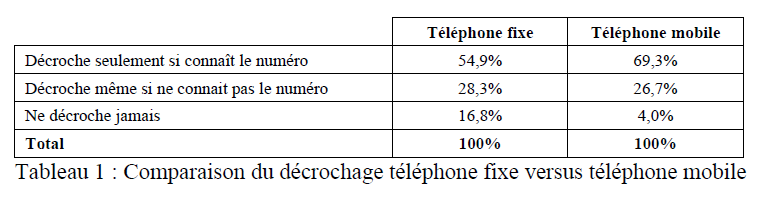
Whether on a cell phone or a landline, a majority of people answer only if they recognize the number calling them, but more people never answer their landline. The percentage of people who answer even if they do not recognize the number is very similar: 28.4% on landlines and 26.7% on cell phones.
Behavior by Age Group
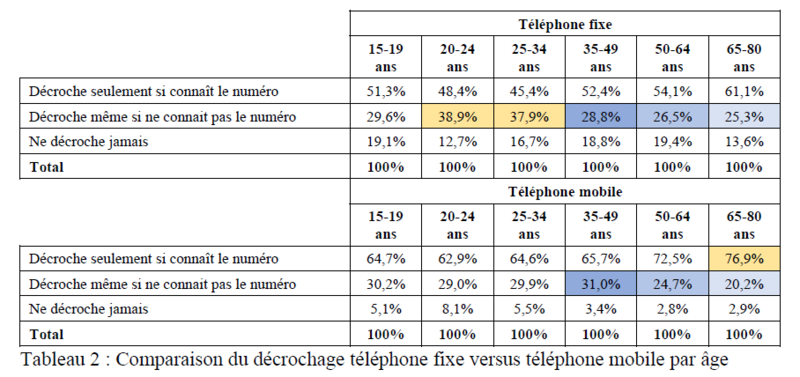
Older people are the most “cautious ”: whether on a landline or cell phone, the response “Answer even if you don’t recognize the number” decreases with age starting at 25. Young adults (ages 20–34) are more likely to answer a call from an unknown number, especially on landlines.
Seniors
Seniors
The name given to people aged 50 years and older. In 1998, France had about 18.6 million seniors, or 39.6% of the population aged 15 years and older and living in an ordinary household.
Find out more
(ages 65–80) are very selective, especially on cell phones: 76.9% of them will only answer if they recognize the number.
Behavior by Socio-Professional Category
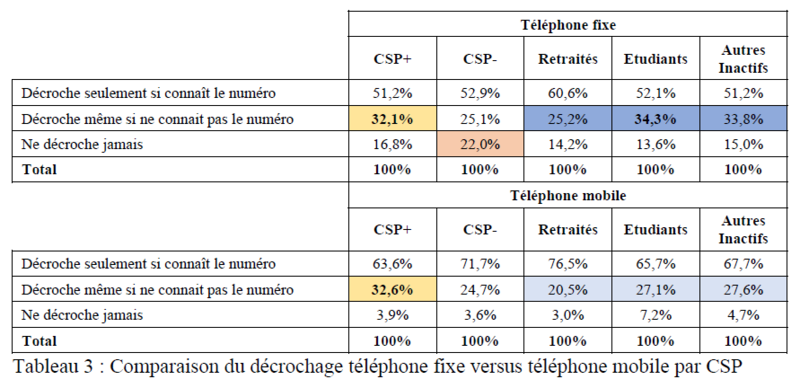
Among the
non-working population
non-working population
According to convention, this category includes those who are neither employed nor unemployed: young people aged under 15 years old, students and pensioners who do not work in addition to their studies or retirement, housewives, people who are incapable of working, etc.
Find out more
, the likelihood of answering a call—regardless of the type of number—is lower on cell phones than on landlines. Among the
working population
working population
The working population is composed of people performing a professional activity, including the unemployed who have already worked.
Find out more
, it is nearly identical on both types of phones and is high among the
Upper SPG categories
Upper SPG categories
This term describes business owners, artisans and merchants, executives, upper-level intellectual professions and intermediate professions.
Find out more
(≈ 32%). The categorical refusal to answer a call on a landline is more common among lower
SPG categories
SPG categories
The SPG (socio-professional category), was replaced in 1982 by the classification of Professions and Socio-professional Categories (PCS), a nomenclature defined by France’s INSEE, which classifies the population according to a combination of profession (or former profession), hierarchical position and status (employee or otherwise).
Find out more
, and their tendency to answer an unknown number is comparable to that observed among retirees. Students (on landlines) and people in Upper SPG categories (on both landlines and cell phones) are the most open to unknown numbers.
Behavior by Gender
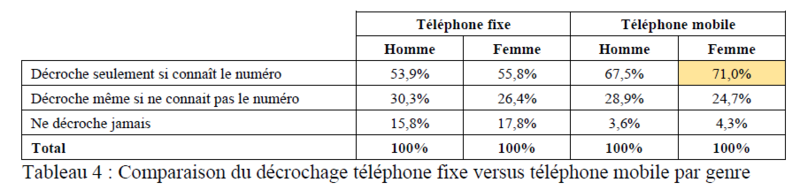
Behaviors are similar, but women are slightly more cautious and selective: a higher percentage of them never answer calls and do not answer if they do not recognize the number. They are more vigilant about their cell phone use, with a maximum selectivity rate of 71%.
Behavior by Place of Residence
Geographically speaking, residents of the Paris
Region
Region
Geographic division. Mainland France is organised into 13 administrative regions (INSEE regions - there were previously 22 regions).
Find out more
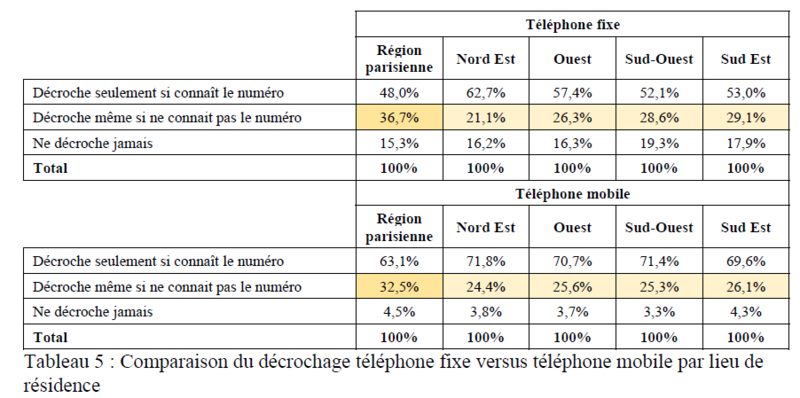
are more likely to hang up when they don’t recognize the number: about two-thirds of them hang up on calls from unknown numbers, whether on a landline or a cell phone.
3.2 Specific Reaction to an Unknown Call on a Landline or Cell Phone
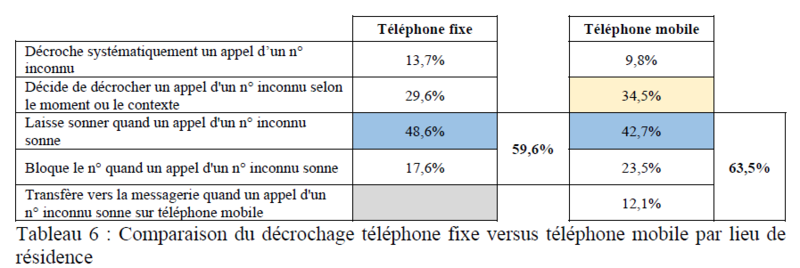
Systematically answering such calls is rare: a small proportion of respondents answer calls from unknown numbers right away—13.7% on landlines and 9.8% on cell phones. Caution toward unknown numbers is the predominant behavior: nearly half of respondents let their phone ring when they receive an unknown call. However, among cell phone users, two-thirds indicate they are likely to answer anyway, if their availability or the situation allows. Blocking numbers is more common on cell phones, but this may be explained by the fact that landlines offer fewer tools for managing calls and that users rely on them less.
When looking at people who are likely not to answer if called back from a number they do not recognize—either because they do not pick up the phone or because they have blocked the number—about 60% of them will not answer.
Reading:
- 9.8% of people with a cell phone always answer calls from unknown numbers on their cell phone, and 23.5% block the number when an unknown number rings on their cell phone. There are mixed patterns of behavior; for example, some respondents answer the call and then choose to block the number afterward.
- 63.5% of people with a cell phone reported letting the call ring, blocking it, and/or forwarding it.
3.3 Classification of User Responses to Unknown Calls on Cell Phones
We examined the profiles of individuals based on their responses to calls from unknown numbers on their cell phones:
- People who answer calls from unknown numbers on their cell phones, depending on their availability at the time of the call, are aged 25 to 49 and belong to the
Upper SPG categories
Upper SPG categories
This term describes business owners, artisans and merchants, executives, upper-level intellectual professions and intermediate professions.
Find out more
,
- Those who let their phones ring have a profile similar to that of cell phone users in terms of age and
SPG categories
SPG categories
The SPG (socio-professional category), was replaced in 1982 by the classification of Professions and Socio-professional Categories (PCS), a nomenclature defined by France’s INSEE, which classifies the population according to a combination of profession (or former profession), hierarchical position and status (employee or otherwise).
Find out more
,
- as for those who block the number and can no longer be reached using that same number, they are predominantly retirees, over 50 years old, and live in northern France.
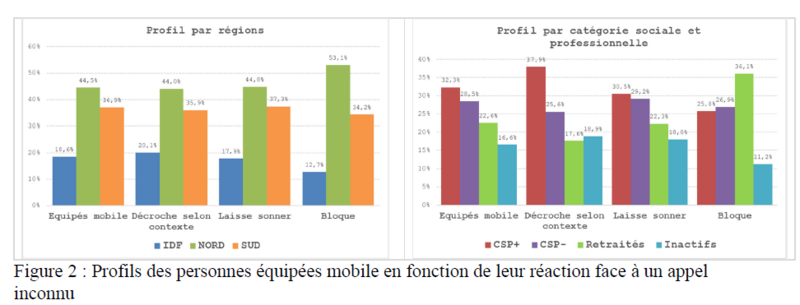
We also examined responses according to various sociodemographic categories.
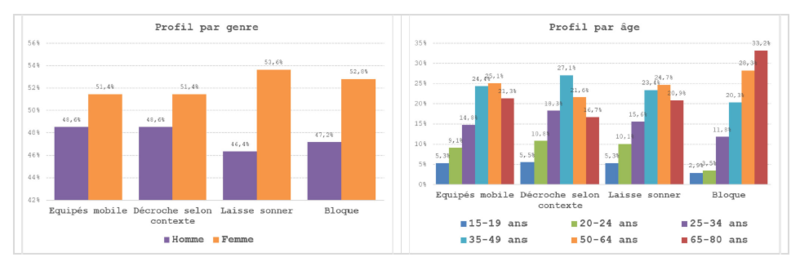
The most common behavior remains avoiding calls from unknown numbers by letting them ring (~41–47%). More women let the phone ring and block the number than men, but the differences are modest: gender does not appear to be a major determining factor ICI.
Blocking increases significantly with age, while answering the call depending on availability peaks among those aged 20–34.
The youngest age group (15–24 years old) fluctuates between letting the phone ring (42.6–47.6%) and answering depending on the situation (35.9–41.1%), with a low rate of blocking (9.1–12.8%): They answer if “it’s convenient,” otherwise they let it ring.
Upper SPG categories
Upper SPG categories
This term describes business owners, artisans and merchants, executives, upper-level intellectual professions and intermediate professions.
Find out more
and the
non-working population
non-working population
According to convention, this category includes those who are neither employed nor unemployed: young people aged under 15 years old, students and pensioners who do not work in addition to their studies or retirement, housewives, people who are incapable of working, etc.
Find out more
other than retirees are more likely to answer based on their availability, while retirees stand out for their high level of hesitation.
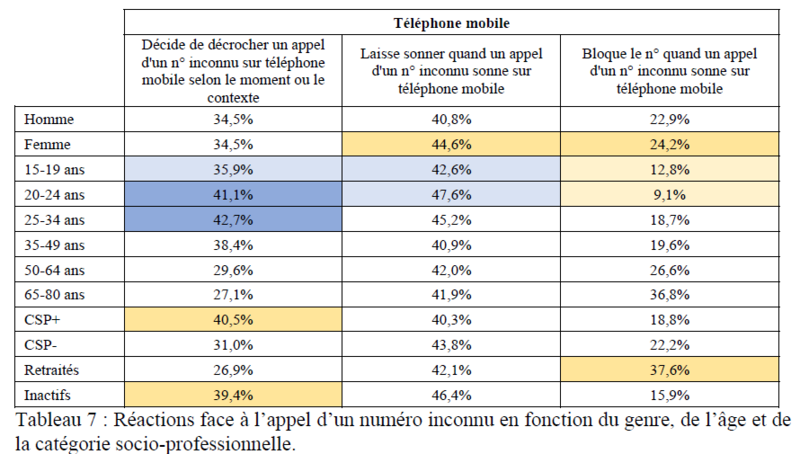
Reading: 47.6% of people aged 20 to 24 let their phone ring when they receive a call from an unknown number on their cell phone.
These descriptive analyses highlight the fact that
Upper SPG categories
Upper SPG categories
This term describes business owners, artisans and merchants, executives, upper-level intellectual professions and intermediate professions.
Find out more
are more likely to answer a call from an unknown number; this group consists of professions where the option to work remotely is most widespread. Research on this topic presented at the 2024
Survey
Survey
A statistical method that aims to produce information about a population by interviewing part of the population (sample). This word is generally used to mean a survey conducted on a sample that have been interviewed using a questionnaire or else systematically observed.
Find out more
Conference3 showed that remote workers appeared to be more willing to answer than others who had worked on the day of the call, and that their willingness to answer was similar to that of people who were not working on the day of the call. This finding is confirmed by the survey: 57% of respondents who reported having the option to work remotely stated that they are more likely to answer a call from an unknown number on their cell phone when they are working remotely.
3 Effects of Telework on Reachability in Telephone Surveys, https://sondages2024.sciencesconf.org/562440/document
3.4 Measures Taken Against Unwanted Calls on Cell Phones
Two out of three people have at least one measure in place to prevent unwanted calls on their cell phones. The phone’s built-in protection is the most commonly cited: 35% report using automatic filtering. The use of an anti-spam app is marginal (7%); those who use this measure tend to be older (those aged 65–80 account for 28.2%, compared to 21.2% of all mobile phone users).
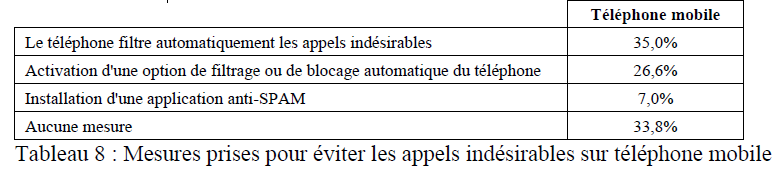
Nearly all users who have installed an anti-spam app (96.7%) have enabled at least one blocking feature, and 21.9% of them go a step further in protecting themselves from unwanted calls by configuring their own custom filtering rules. The most common feature is blocking numbers reported as spam.
4. Additional Analyses
Additional analyses aimed at explaining and performing segmentation segmentation A data processing technique whose purpose is to divide a population into several homogeneous groups according to different characteristics which were chosen for their capacity to differentiate. Find out more of reachability behaviors on landlines and/or cell phones when faced with unknown numbers were presented at the 2026 conference. Based on the lessons learned, adjustments may be implemented in the field field All the operations that structure the work of interviewers: description of the interviewees, instructions for choosing the interviewees, quotas, administering the questionnaire, quality controls, etc. The entire physical system (rooms, personal computers, telephones, etc.) used for telephone surveys, and the related organisation is called the “telephone field”. Find out more to optimize the collection of our samples.
Bibliography
-
ARCEP
ARCEP
The Autorité de Régulation des Communications Électroniques et des Postes (Electronic and postal communications regulator) is an independent administrative authority that was created on 5 January 1997 as the ART – Autorité de Régulation des Télécommunications (Telecoms Regulatory Authority). ARCEP is the architect and guardian of exchange networks in France. It ensures that the market is open to new players and to all forms of innovation. ARCEP works alongside the public authorities to extend connectivity right across France and runs the framework for network interoperability.
Find out more
(2019), Decision No. 2019‑0954 amending Decision No. 2018‑0881 establishing the national numbering plan and its management rules, and including measures to combat unsolicited calls and messages, https://www.arcep.fr/uploads/tx_gsavis/19-0954.pdf
- Gouvernement Francais (2020), Law No. 2020-901 of July 24, 2020, regulating telemarketing and combating fraudulent calls, https://www.legifrance.gouv.fr/loda/id/JORFTEXT000042148119
- ARCEP (2024), Annual
Survey
Survey
A statistical method that aims to produce information about a population by interviewing part of the population (sample). This word is generally used to mean a survey conducted on a sample that have been interviewed using a questionnaire or else systematically observed.
Find out more
of User
Satisfaction
Satisfaction
An area of study into consumer behaviour that aims to define the satisfaction or appreciation experienced by the user of a good, a product, or a service. Two complementary approaches are distinguished: understanding the process of forming satisfaction on one hand, and measuring the satisfaction on the other.
Find out more
with Mobile Operators and Internet Service Providers, https://www.arcep.fr/fileadmin/user_upload/observatoire/satisfaction-client/avril-">https://www.arcep.fr/fileadmin/user_upload/observatoire/Satisfaction-client/april- 2025/observatoire_Satisfaction_client_edition_2025_april2025.pdf
- National Assembly (2025), Bill on
Consent
Consent
Any freely given, specific, informed and unambiguous indication of the data subject's wishes through which he or she, by a statement or by a clear affirmative action, signifies agreement to the processing of personal data relating to him or her. It is one of the six legal bases provided for by the GDPR.
Find out more
-Based Telemarketing, https://www.assemblee-nationale.fr/dyn/17/dossiers/DLR5L17N51563