
Audiences and Results Radio
Radio Audiences: Key ratings, audience shares and trends to help you understand how audiences engage with radio.
EAR > Global Radio - January–March 2026
New record: 11.3 million daily listeners on digital digital A signal is said to be digital if it can be represented by a series of discrete values that can be coded in binary as either 0 or 1. It is the opposite of analogue signal. Digital broadcasting has become the primary mode for television broadcasting, whether by cable, satellite, or even terrestrial. Find out more platforms
Every day, 38.4 million French people aged 13 and older listen to the radio. This audience audience The set of listeners, viewers, or TV viewers in which each individual is equally weighted, regardless of their listening/viewing duration or frequency of contact. Find out more , measured in the EAR > National survey survey A statistical method that aims to produce information about a population by interviewing part of the population (sample). This word is generally used to mean a survey conducted on a sample that have been interviewed using a questionnaire or else systematically observed. Find out more , takes into account all listening mediums, including both dedicated radio devices and digital devices.
The EAR > Global Radio module analyzes digital radio listening behavior.
Every day, 11.3 million people listen to the radio on digital devices, representing 19.8% of the population population The universe of a survey composed of basic statistical units. These units may be physical persons, households, companies, municipalities, etc. The population serves as a sampling frame for selecting a sample, and as a basis for calculation of the extrapolations from the sample. Find out more aged 13 and older. In one year, radio gained 877,000 daily listeners on these mediums.
This growth in radio listening via digital platforms is driven by mobile phones, which account for 7.7 million daily users. Among other mediums, computers and Voice-controlled Speakers each attract 1.5 million listeners every day, outpacing television, which is chosen by 1 million listeners.
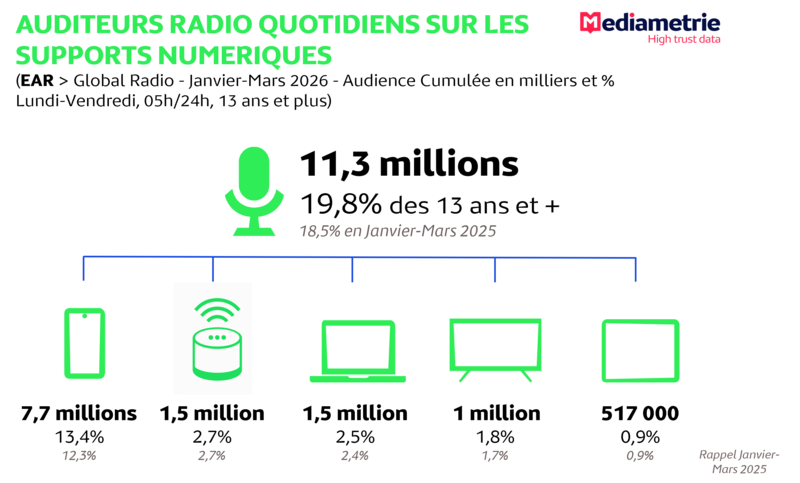
Listening to the radio on digital digital A signal is said to be digital if it can be represented by a series of discrete values that can be coded in binary as either 0 or 1. It is the opposite of analogue signal. Digital broadcasting has become the primary mode for television broadcasting, whether by cable, satellite, or even terrestrial. Find out more media continues to be particularly popular among 35- to 59-year-olds (25.4% of them listen to the radio every day on digital media, up 1.7 percentage points in one year), Upper SPG categories Upper SPG categories This term describes business owners, artisans and merchants, executives, upper-level intellectual professions and intermediate professions. Find out more (26.7%, up 1.6 percentage points), and residents of the Île-de-France region region Geographic division. Mainland France is organised into 13 administrative regions (INSEE regions - there were previously 22 regions). Find out more (23.5%, up 0.8 percentage points). Listening to the radio on digital platforms is attracting an increasingly broad audience audience The set of listeners, viewers, or TV viewers in which each individual is equally weighted, regardless of their listening/viewing duration or frequency of contact. Find out more , with growth among lower SPG categories SPG categories The SPG (socio-professional category), was replaced in 1982 by the classification of Professions and Socio-professional Categories (PCS), a nomenclature defined by France’s INSEE, which classifies the population according to a combination of profession (or former profession), hierarchical position and status (employee or otherwise). Find out more (18.2%, up 1.5 points) and those aged 60 and older (16%, +1.4 percentage points).
Digital radio listeners tune in for an average average The average is one of the most important statistical indicators for a set of numbers. By default, it is the arithmetic mean, calculated by adding the values in the set and then dividing that sum by the number of values. Find out more of 2 hours and 31 minutes on these mediums, exceeding the average listening time of radio listeners using dedicated devices (2 hours and 25 minutes).
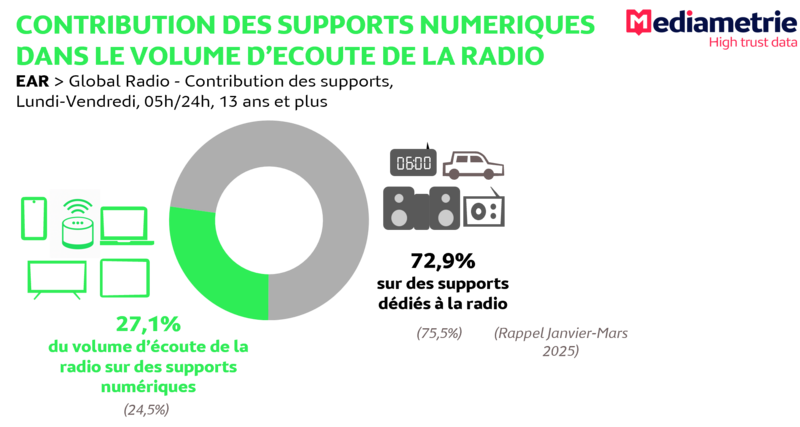
In total, these 11.3 million digital radio listeners account for 27.1% of total radio listening time, compared to 24.5% last year.
Survey Survey A statistical method that aims to produce information about a population by interviewing part of the population (sample). This word is generally used to mean a survey conducted on a sample that have been interviewed using a questionnaire or else systematically observed. Find out more Characteristics
EAR > Global Radio is part of Médiamétrie’s MediaEAR universe universe All the statistical units from which a survey sample is drawn. When these units are people, the universe is termed a population. Find out more of services
The Global Radio module is integrated into the January–March and September–October Survey Waves of the EAR > National survey. It specifically measures radio audiences on digital digital A signal is said to be digital if it can be represented by a series of discrete values that can be coded in binary as either 0 or 1. It is the opposite of analogue signal. Digital broadcasting has become the primary mode for television broadcasting, whether by cable, satellite, or even terrestrial. Find out more platforms and their contribution to overall radio listening. The EAR > National survey measures radio audiences in France regardless of location or listening medium medium In the broad sense, any means of communication that could convey an advertising message. This is also the name given to various components of a media: TV networks, radio stations, press titles, etc. Find out more