
Audiences and Results Radio
Radio Audiences: Key ratings, audience shares and trends to help you understand how audiences engage with radio.
EAR > Global Audio 2026
With 96% of listeners each month and rising
digital
digital
A signal is said to be digital if it can be represented by a series of discrete values that can be coded in binary as either 0 or 1. It is the opposite of analogue signal. Digital broadcasting has become the primary mode for television broadcasting, whether by cable, satellite, or even terrestrial.
Find out more
usage, audio is becoming
firmly established in France
The Global Audio study study Any research done across a population, line of business, or products (programme content, programme schedules, etc.) A study relies most often on the data coming out of a survey (or surveys). Find out more analyzes all audio uses and provides a consolidated and precise view of audio consumption in France among 15-80 year-olds.
A powerful audio universe universe All the statistical units from which a survey sample is drawn. When these units are people, the universe is termed a population. Find out more that benefits from the widespread adoption of digital digital A signal is said to be digital if it can be represented by a series of discrete values that can be coded in binary as either 0 or 1. It is the opposite of analogue signal. Digital broadcasting has become the primary mode for television broadcasting, whether by cable, satellite, or even terrestrial. Find out more technology
With nearly 50 million listeners (96% of 15- to 80-year-olds) each month in France, audio reaffirms its central role in media consumption, while continuing its transformation.
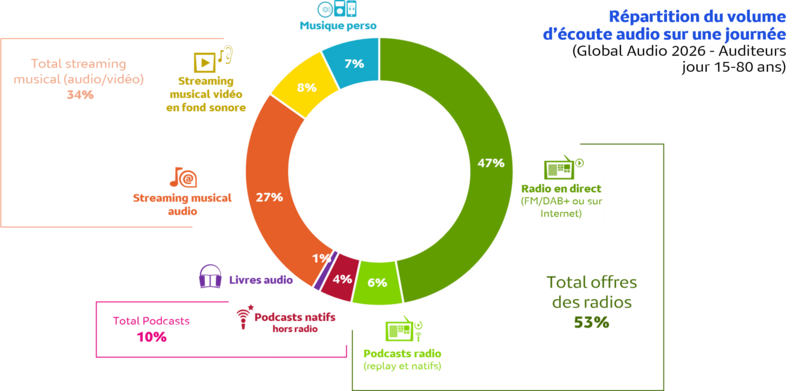
On an average day average day Data relating to an average day correspond to the arithmetic mean of the corresponding data over the different days of the week, with this average being calculated over all of the weeks in the period studied. The idea of the average day Monday-Friday is also used: the week is then limited to five days. Find out more , radio accounts for 53% of total audio listening time, a share that remains broadly stable. At the same time, podcasts (radio and native) continue to grow, reaching 10% of the total volume (up 2 points in one year). Audio music Streaming Streaming A technical method of digitally transmitting data to enable the playback of a continuous flow of video and audio material. Unlike terrestrial or satellite TV broadcasting, this technology requires a two-way network (internet) to send periodic requests to the streaming server in order to receive video or audio micro-files. Find out more accounts for 27% of listening time (+1 point), while video music Streaming declines to 8% (–2 points).
The usage structure is evolving without challenging the hierarchy : radio remains central and strong, while digital formats are becoming firmly established.
In this context, digital digital A signal is said to be digital if it can be represented by a series of discrete values that can be coded in binary as either 0 or 1. It is the opposite of analogue signal. Digital broadcasting has become the primary mode for television broadcasting, whether by cable, satellite, or even terrestrial. Find out more audio is becoming a cross-generational standard : 85% of listeners use it every month (+4 points in one year). This growth now extends to all demographics, and is accelerating particularly among 35- to 64-year-olds (90%; +6 percentage points over the past year), a sign of widespread adoption. This is accompanied by a shift toward mobile, which has become the leading medium medium In the broad sense, any means of communication that could convey an advertising message. This is also the name given to various components of a media: TV networks, radio stations, press titles, etc. Find out more for listening, accounting for 40% of the time spent listening to audio in general (+5 percentage points in one year). Mobile is thus establishing itself as the primary entry point for audio consumption.

Methodology
Global Audio is part of Médiamétrie’s MediaEAR universe universe All the statistical units from which a survey sample is drawn. When these units are people, the universe is termed a population. Find out more .
The Global Audio study study Any research done across a population, line of business, or products (programme content, programme schedules, etc.) A study relies most often on the data coming out of a survey (or surveys). Find out more measures audio usage (reach, duplication, listener listener Someone who is listening to a radio station, an aggregate of stations or a coordination; this generic term can also be used for television (however, its preferred term is "TV viewer"). Find out more profile, and listening volume) and listening contexts (locations, media, listening times).
The scope of the study includes live radio (FM/DAB+ or via the internet), Radio podcasts (Catch-up and native) and non-radio podcasts, audiobooks, music streaming streaming A technical method of digitally transmitting data to enable the playback of a continuous flow of video and audio material. Unlike terrestrial or satellite TV broadcasting, this technology requires a two-way network (internet) to send periodic requests to the streaming server in order to receive video or audio micro-files. Find out more services (free and subscription-based), background music Streaming on video platforms, and personal music libraries (CDs, MP3s, individual track purchases, vinyl, etc.).
The study was conducted online (CAWI) in February/March 2026 among a
sample
sample
A subset of the population studied, selected in accordance with a sampling plan, and subject to the collection of information.
Find out more
of
4,152 individuals aged 15 to 80,
representative
representative
A sample is said to be representative when it has been generated via a representative draw, meaning that each individual in the population had a non-zero probability of being selected. Representativeness relates to the sample and not to a unit of the population. It is not synonymous with a proportional sample or a "reduced model" of the population studied. In survey theory, it has been demonstrated that an optimal sampling strategy consists of organising the sample according to the variables that are most correlated to the subject of the study.
Find out more
of the French
population
population
The universe of a survey composed of basic statistical units. These units may be physical persons, households, companies, municipalities, etc. The population serves as a sampling frame for selecting a sample, and as a basis for calculation of the extrapolations from the sample.
Find out more
in terms of the sociodemographic criteria of gender, age,
SPG categories
SPG categories
The SPG (socio-professional category), was replaced in 1982 by the classification of Professions and Socio-professional Categories (PCS), a nomenclature defined by France’s INSEE, which classifies the population according to a combination of profession (or former profession), hierarchical position and status (employee or otherwise).
Find out more
, and geographic
distribution
distribution
This refers to the distribution of a variable; “structure” is also used with this meaning. In statistics, for each x value of a quantitative variable, the distribution function gives the proportion of individuals having a variable value that is less than or equal to x.
Find out more
.