Media Equipment Barometer by Médiamétrie
Understanding media usage starts with a simple yet fundamental question: what hardware devices do households own? The Médiamétrie Equipment Barometer Barometer By analogy with meteorology, this term designates any regular measurement that can give an account of changes in audience, opinion, image, etc. Find out more was created precisely to answer this question question An inquiry posed in the same way to all participants in the same survey, with the goal of obtaining answers of the same nature. We distinguish closed questions whose responses are chosen from the options provided (scales, yes / no, classification options, etc.), from open-ended questions for which no answer categories are offered. In the latter case, the spontaneous answer of the interviewee is gathered. Find out more .
The Media Equipment Barometer is a benchmark study study Any research done across a population, line of business, or products (programme content, programme schedules, etc.) A study relies most often on the data coming out of a survey (or surveys). Find out more designed to decode the foundations of current digital digital A signal is said to be digital if it can be represented by a series of discrete values that can be coded in binary as either 0 or 1. It is the opposite of analogue signal. Digital broadcasting has become the primary mode for television broadcasting, whether by cable, satellite, or even terrestrial. Find out more habits. Conducted every six months, this key tool monitors the technological landscape to deeply understand and anticipate digital and media trends. Indeed, the proliferation of multimedia devices directly contributes to transforming consumer behaviors and content consumption patterns.
Key figures of the French technological landscape
The proliferation of screens at home
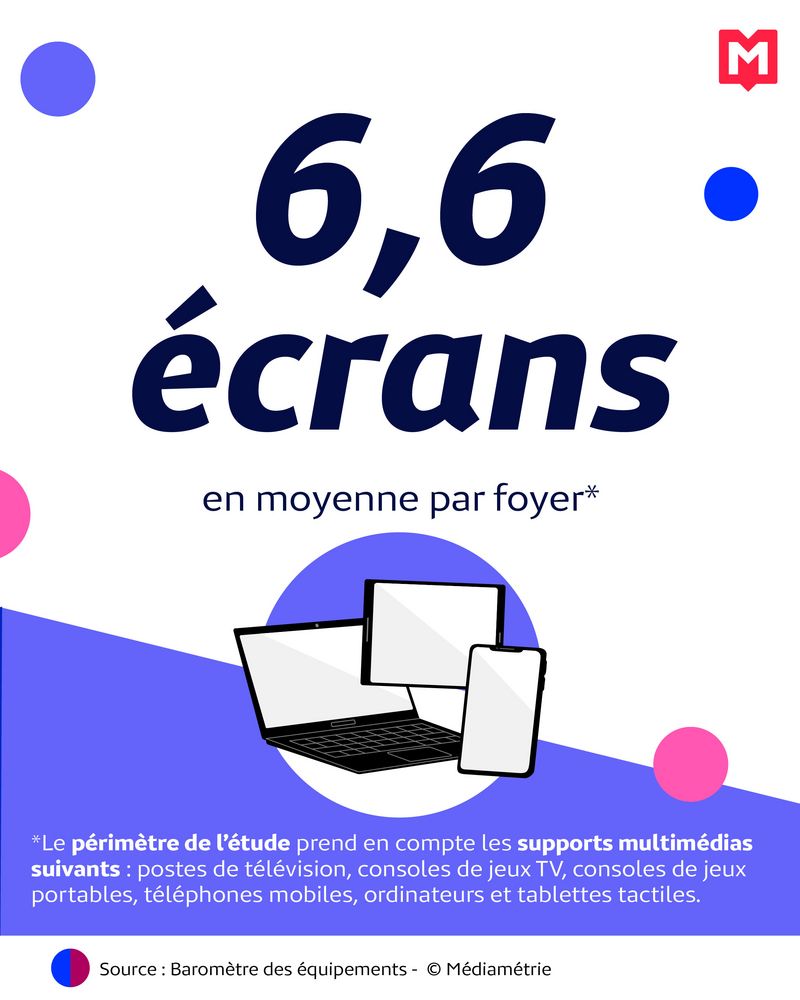
The digitization of households translates into an abundance of devices. Today, French households own an average average The average is one of the most important statistical indicators for a set of numbers. By default, it is the arithmetic mean, calculated by adding the values in the set and then dividing that sum by the number of values. Find out more of 6.6 screens.
The scope of this study study Any research done across a population, line of business, or products (programme content, programme schedules, etc.) A study relies most often on the data coming out of a survey (or surveys). Find out more includes a wide variety of multimedia devices, illustrating the fragmentation of media usage:
- Television sets;
- Mobile phones (smartphones);
- Computers;
- Tablets;
- Home video game consoles;
- Handheld video game consoles.
Connectivity and reception methods
Beyond simple screen ownership, the Media Equipment Barometer Barometer By analogy with meteorology, this term designates any regular measurement that can give an account of changes in audience, opinion, image, etc. Find out more looks at connectivity, an essential prerequisite for a seamless digital digital A signal is said to be digital if it can be represented by a series of discrete values that can be coded in binary as either 0 or 1. It is the opposite of analogue signal. Digital broadcasting has become the primary mode for television broadcasting, whether by cable, satellite, or even terrestrial. Find out more experience. The data data Digital data Find out more reveals that nearly 9 out of 10 households have a Broadband Internet connection at home.
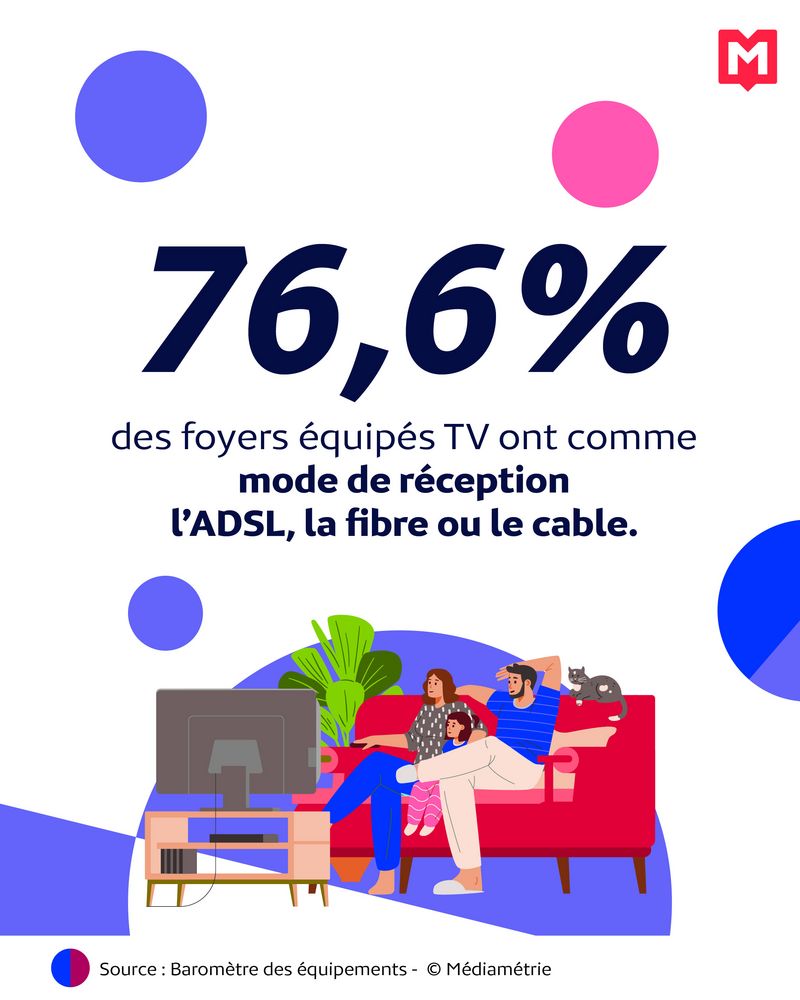
Regarding traditional and non-linear television viewing (on-demand/catch-up), the access method has significantly evolved: 76.6% of TV-equipped TV-equipped According to the Médiamat convention, a "TV-equipped" home is a one where a television set is used at least once a month. The "TV-equipped" population is the reference population for Médiamat. Find out more households now use ADSL ADSL ADSL (Asymmetric Digital Subscriber Line) is a data transmission technology over traditional telephone lines using a higher band of frequencies than those used for telephony. The download speed is higher than the upload speed. Find out more , fiber optics, or cable cable A television broadcast method that differs from terrestrial broadcasting and satellite broadcasting. The signal is transported via a cable into the home. N.B.: some fibre-optic networks end with cable over the last 100 metres (Hybrid Fibre-Coaxial technology). Find out more as their primary reception method.