
Will We Still Conduct Surveys and Audience Measurement in 2030? Collecting Data When Everything Stands in the Way
By Yannick Carriou, President and CEO of Médiamétrie
14th Francophone Symposium on Surveys, May 19–22, 2026, Vannes

Abstract
Telephone contactability has become one of the most severe constraints on the production of representative representative A sample is said to be representative when it has been generated via a representative draw, meaning that each individual in the population had a non-zero probability of being selected. Representativeness relates to the sample and not to a unit of the population. It is not synonymous with a proportional sample or a "reduced model" of the population studied. In survey theory, it has been demonstrated that an optimal sampling strategy consists of organising the sample according to the variables that are most correlated to the subject of the study. Find out more data data Digital data Find out more . Over the past decade, response rates in telephone surveys have collapsed across industrialised countries. In the United States, the Pew Research Center documents a fall from 36% in 1997 to less than 6% in 2018, ultimately leading the institution to abandon outbound telephone polling entirely in 2022. In France, Médiamétrie's survey survey A statistical method that aims to produce information about a population by interviewing part of the population (sample). This word is generally used to mean a survey conducted on a sample that have been interviewed using a questionnaire or else systematically observed. Find out more operations record historically low pick-up rates, while immediate refusals and calls terminated before any argumentation can be made continue to rise. This deterioration is not cyclical: it reflects the convergence convergence Coming together of domains or applications linked with technologies based on similar functions. Thus, the emergence and increased commonality of the digital signal allow for the convergence of the audio-visual, consumer electronics, computing, and telecommunications sectors. Find out more of three structural dynamics.
The first is behavioural. A growing fraction of the population population The universe of a survey composed of basic statistical units. These units may be physical persons, households, companies, municipalities, etc. The population serves as a sampling frame for selecting a sample, and as a basis for calculation of the extrapolations from the sample. Find out more deliberately refuses to answer calls from unknown numbers, driven by distrust of commercial canvassing and telephone fraud. The ARCEP ARCEP The Autorité de Régulation des Communications Électroniques et des Postes (Electronic and postal communications regulator) is an independent administrative authority that was created on 5 January 1997 as the ART – Autorité de Régulation des Télécommunications (Telecoms Regulatory Authority). ARCEP is the architect and guardian of exchange networks in France. It ensures that the market is open to new players and to all forms of innovation. ARCEP works alongside the public authorities to extend connectivity right across France and runs the framework for network interoperability. Find out more Annual User Satisfaction Satisfaction An area of study into consumer behaviour that aims to define the satisfaction or appreciation experienced by the user of a good, a product, or a service. Two complementary approaches are distinguished: understanding the process of forming satisfaction on one hand, and measuring the satisfaction on the other. Find out more Survey (2025 edition) finds that over 70% of mobile users encounter fraud or unwanted calls on a weekly basis, leading a majority of them not to answer unrecognised numbers. This heightened vigilance translates into growing selectivity that penalises canvassers and survey researchers alike.
The second dynamic is technological. Smartphones now integrate AI-powered call-filtering systems operating at three cumulative levels: at network level (operators' anti-spam services), at device level (native iOS and Android functions), and at the application layer (community-based platforms such as Truecaller or Hiya). These systems, designed to block abusive canvassing, are blind to the purpose of calls: survey fieldwork, which structurally generates high call volumes and substantial non-pick-up rates, triggers exactly the same detection algorithms as commercial call centres.
The third dynamic is regulatory. The ARCEP's introduction of Verified Multipurpose Numbers (NPV) on 1 January 2023, intended to authenticate legitimate calls, paradoxically worsened the situation for researchers. By making survey institutes explicitly identifiable through their number prefixes, this measure accelerated their conflation with commercial canvassing in users' minds. INED data show a first-call pick-up rate of 5.7% for NPV numbers versus 21.7% for standard numbers on landlines — a fourfold disadvantage. Moreover, operators regularly block survey institutes' NPV numbers mid-session without legal basis, forcing providers into a permanent rotation of their number pool — precisely the same strategy used by fraudulent actors that the regulation was designed to combat.
In response to this paradox, the Act of 30 June 2025 (loi n° 2025-594) created a new category of numbers — NPAIG (Numéros Polyvalents pour les Appels et messages d'Intérêt Général, i.e. Multipurpose Numbers for Calls and Messages of General Interest) — reserved for entities designated by ministerial order. While this legislative advance is real, its operational applicability remains suspended, at the time of this communication, pending publication of that order. It also faces a structural limitation: private filtering systems (scoring platforms, device manufacturers, operators) have no legal obligation to align their algorithms with national regulatory categories.
In addressing these challenges, two pitfalls must be avoided. First, assuming that contactability will stabilise spontaneously, when all available signals point to continued deterioration. Second, yielding to the appeal of synthetic data as a general solution: while such approaches offer promising prospects for strengthening the representativeness of under-surveyed subpopulations, their conditions of statistical validity remain to be rigorously established, and hasty adoption risks substituting a semblance of an answer for a real problem.
The appropriate response is collective and political. It requires that public and private actors in statistics statistics Statistics or Data Science is a field of mathematics that studies phenomena through data collection, processing, analysis, graphical representation and visualisation (Data Visualisation), as well as the interpretation of results. Find out more and audience measurement audience measurement Quantitative study of the frequency of use of media. Find out more speak with one voice to national and European regulators, drawing notably on Article 24 of the European Media Freedom Act (EMFA, 2024), which explicitly recognises the public-interest nature of independent audience measurement. Only by transcending institutional boundaries to collectively defend the infrastructure for producing representative data can the contactability crisis be met with a response commensurate with its democratic stakes.
Introduction
The production of economic and social data data Digital data Find out more constitutes one of the fundamental—and often invisible—infrastructures of contemporary democracies. It is not limited to the public statistics statistics Statistics or Data Science is a field of mathematics that studies phenomena through data collection, processing, analysis, graphical representation and visualisation (Data Visualisation), as well as the interpretation of results. Find out more missions entrusted to INSEE INSEE The Institut National de la Statistique et des Études Économiques (National Institute for Statistics and Economic Studies) is a general directorate of France's Ministry of the Economy, Finance, and Industry. INSEE carries out several sample surveys in the socio-economic field (households, companies), in addition to its responsibilities for the national accounts and taking the census (last completed in March 1999). This government agency is responsible for coordinating official statistics, reference data produced by the entire public statistics system. Find out more , Eurostat, or ministerial statistical offices: it encompasses a private ecosystem of polling institutes and audience measurement audience measurement Quantitative study of the frequency of use of media. Find out more firms including those that provide data for daily public, economic, and cultural decision-making.
Among these data producers, institutes specializing in Media Audience Measurement occupy a unique position, one that is increasingly emphasized by national and European lawmakers. Their data does more than simply describe media consumption patterns: it serves as a Barometer Barometer By analogy with meteorology, this term designates any regular measurement that can give an account of changes in audience, opinion, image, etc. Find out more of the state of society. Audience Measurement for television, radio, digital digital A signal is said to be digital if it can be represented by a series of discrete values that can be coded in binary as either 0 or 1. It is the opposite of analogue signal. Digital broadcasting has become the primary mode for television broadcasting, whether by cable, satellite, or even terrestrial. Find out more media, and print media helps us understand which content reaches which populations, in which regions, and at what times of day—all information that sheds light on the dynamics of collective attention, generational divides, and the risks of influence.
The civic significance of this data extends far beyond the commercial sphere: it informs legislative debate and the evaluation of public policies. Young people’s digital habits provide a particularly striking illustration of this. In France, the report by the Commission on Children and Screens, submitted to the Élysée Palace in April 2024, drew on digital usage data—including data from Médiamétrie’s Digital Barometer—to document the extent of minors’ exposure to social media. This report directly informed Law No. 2024-449 of May 21, 2024, aimed at combating minors’ exposure to online pornographic content, and subsequently the parliamentary deliberations on banning social media for children under 15. Measuring the actual effectiveness of such a ban—determining whether 13- or 14-year-olds have in fact reduced their use of TikTok or Instagram—will require precisely the Audience Measurement tools produced by these same research firms. Audience Audience The set of listeners, viewers, or TV viewers in which each individual is equally weighted, regardless of their listening/viewing duration or frequency of contact. Find out more data is thus both the foundation of the analysis and the tool for evaluation.
However, producing this data is becoming structurally more difficult—and therefore more costly. For the past decade, survey survey A statistical method that aims to produce information about a population by interviewing part of the population (sample). This word is generally used to mean a survey conducted on a sample that have been interviewed using a questionnaire or else systematically observed. Find out more research has faced a continuous decline in the reachability of its target target A subset of the population which we aim to reach with a show or advertising campaign. The target is defined using socio-demographic, equipment, or behavioural characteristics. Find out more audiences: response rates are falling, refusal rates are rising, fieldwork is taking longer, and production costs are skyrocketing. This trend, documented in the international literature on non-response non-response People solicited to participate in a statistical survey do not always respond - in this case they are called non-responses. “Total non-response” cases (when a person contacted for a survey does not respond to any question at all) are distinguished from “partial non-response” cases (when the interviewee responds to some questions, but not others). Find out more , has accelerated significantly in France over the past five years, reaching historically alarming levels.
In the face of this crisis, the question question An inquiry posed in the same way to all participants in the same survey, with the goal of obtaining answers of the same nature. We distinguish closed questions whose responses are chosen from the options provided (scales, yes / no, classification options, etc.), from open-ended questions for which no answer categories are offered. In the latter case, the spontaneous answer of the interviewee is gathered. Find out more of how to contact contact In media planning, a contact refers to an individual's exposure to an advertisement. In radio parlance, this is Opportunity to Hear (OTH) and for TV, Internet, press, cinema and poster advertisements, it is called Opportunity to See (OTS). Find out more respondents is central. In theory, the most robust data collection relies on the creation of a random sample sample A subset of the population studied, selected in accordance with a sampling plan, and subject to the collection of information. Find out more drawn from a comprehensive population population The universe of a survey composed of basic statistical units. These units may be physical persons, households, companies, municipalities, etc. The population serves as a sampling frame for selecting a sample, and as a basis for calculation of the extrapolations from the sample. Find out more database database All the homogeneous data collected over the course of several surveys and whose structure provides the potential for tailor-made consultations and inquiries. Find out more ; in France, the Census Census A technique for gathering information across the entire population, in contrast to a survey, which by definition only applies to a sample. Normally, a census involves an exhaustive count during which some additional socio-demographic questions are asked. Example: the national population census in France by INSEE which publishes results annually. Find out more administered by INSEE serves as such a master database. However, access to it for the purposes of private surveys is strictly regulated by the Public Statistics Code (Law No. 51-711 of June 7, 1951, as amended), which reserves it exclusively for government agencies and certain authorized public bodies.
Given these structural constraints, the telephone remains the preferred method of contact for representative representative A sample is said to be representative when it has been generated via a representative draw, meaning that each individual in the population had a non-zero probability of being selected. Representativeness relates to the sample and not to a unit of the population. It is not synonymous with a proportional sample or a "reduced model" of the population studied. In survey theory, it has been demonstrated that an optimal sampling strategy consists of organising the sample according to the variables that are most correlated to the subject of the study. Find out more surveys requiring random sampling across the entire population, via random digit dialing (RDD). It offers decisive advantages: it makes it possible to reach reach Reach is the term used to describe the reach achieved by a medium, publication, advertisement or campaign. It corresponds to the number of users reached and is therefore quantitative data. Reach plays a key role in measuring return on investment. It is used to determine whether or not the communication is effective. Whether for a website or a social network, reach corresponds to the proportion of the Internet user population or the audience reached by the site or network over a set period. Find out more individuals not enrolled in panels, to reach populations that are less connected or less willing to respond spontaneously to online surveys, and to construct samples whose representativeness can be verified using robust adjustment adjustment A statistical processing that aims to correct structural discrepancies on one or more variables between the sample and the entire population studied (based on a known structure, such as a census or a framing study). This processing involves the calculation of a so-called adjustment coefficient for each individual surveyed. The coefficient is then combined with the extrapolation to arrive at its weight and thus align the weighted sample's structure to the structure of the population. Find out more methods. However, this method is currently facing three converging trends that are severely undermining its effectiveness.
The first is behavioral: a growing proportion of our fellow citizens deliberately refuse to answer calls from numbers they do not recognize—due to reluctance toward telemarketing, mistrust of phone scams, or disinterest in unsolicited solicitations. ARCEP ARCEP The Autorité de Régulation des Communications Électroniques et des Postes (Electronic and postal communications regulator) is an independent administrative authority that was created on 5 January 1997 as the ART – Autorité de Régulation des Télécommunications (Telecoms Regulatory Authority). ARCEP is the architect and guardian of exchange networks in France. It ensures that the market is open to new players and to all forms of innovation. ARCEP works alongside the public authorities to extend connectivity right across France and runs the framework for network interoperability. Find out more ’s Annual User Satisfaction Satisfaction An area of study into consumer behaviour that aims to define the satisfaction or appreciation experienced by the user of a good, a product, or a service. Two complementary approaches are distinguished: understanding the process of forming satisfaction on one hand, and measuring the satisfaction on the other. Find out more Survey (2025 edition) estimates that more than 70% of mobile users are confronted with fraud or unwanted calls each week, leading a majority of them to avoid answering calls from unknown numbers.
The second is technological: smartphones now come equipped with built-in filtering mechanisms powered by artificial intelligence, which dynamically identify and block unknown calls before they even reach the recipient.
The third is regulatory: ARCEP’s introduction, effective January 1, 2023, Verified Multipurpose Numbers (NPV), designed to authenticate legitimate calls, has paradoxically increased public mistrust by making polling organizations explicitly identifiable and, in the eyes of many users, comparable to telemarketers. At the same time, Law No. 2020-901 of July 24, 2020, governing telemarketing, has strengthened consumer protections as part of a regulatory trend that is not particularly favorable to telephone survey activities. At the European level, certain proposed regulations risk—by blurring the lines between Audience Measurement and marketing targeting targeting An action to define or create a target. Find out more activities—compromising independent Audience Measurement and, paradoxically, leaving the field field All the operations that structure the work of interviewers: description of the interviewees, instructions for choosing the interviewees, quotas, administering the questionnaire, quality controls, etc. The entire physical system (rooms, personal computers, telephones, etc.) used for telephone surveys, and the related organisation is called the “telephone field”. Find out more open to self-measurement by major international platforms.
It is within this context—which encompasses civic, economic, technological, and regulatory—this communication includes a precise analysis of the crisis and identifies avenues for collective action.
2. The Structural Decline in Response Rates to Telephone Surveys
The decline in telephone reach reach Reach is the term used to describe the reach achieved by a medium, publication, advertisement or campaign. It corresponds to the number of users reached and is therefore quantitative data. Reach plays a key role in measuring return on investment. It is used to determine whether or not the communication is effective. Whether for a website or a social network, reach corresponds to the proportion of the Internet user population or the audience reached by the site or network over a set period. Find out more is neither a recent phenomenon nor limited to a specific region region Geographic division. Mainland France is organised into 13 administrative regions (INSEE regions - there were previously 22 regions). Find out more : it is a structural trend that has been documented for several decades on an international scale. The most comprehensive long-term data data Digital data Find out more comes from the Pew Research Center, including its time series on telephone response rates, which are widely cited in the global academic literature.
In its seminal 2012 report (Assessing the Representativeness of Public Opinion Surveys), Pew documents a dramatic decline: the response rate to a standard telephone survey survey A statistical method that aims to produce information about a population by interviewing part of the population (sample). This word is generally used to mean a survey conducted on a sample that have been interviewed using a questionnaire or else systematically observed. Find out more was 36% in 1997; it fell to 25% in 2003, 15% in 2009, and stood at just 9% in 2012—a fourfold decrease over fifteen years. This decline reflects two concurrent phenomena: the collapse of the contact contact In media planning, a contact refers to an individual's exposure to an advertisement. In radio parlance, this is Opportunity to Hear (OTH) and for TV, Internet, press, cinema and poster advertisements, it is called Opportunity to See (OTS). Find out more rate (from 90% of households in 1997 to 62% in 2012) and the drop in the cooperation rate among contacted households (from 43% to 14% over the same period).
Figure 1: Trends in Response Rates to Telephone Surveys (Pew Research Center, 2019)
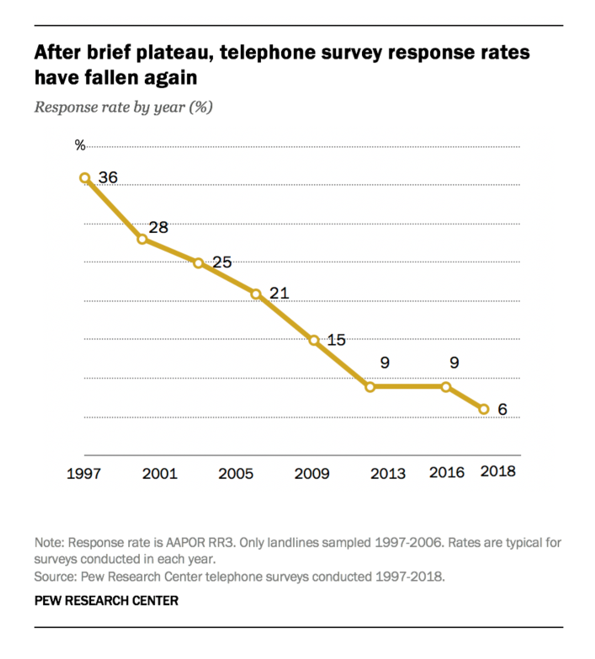
In 2017, a new study study Any research done across a population, line of business, or products (programme content, programme schedules, etc.) A study relies most often on the data coming out of a survey (or surveys). Find out more (“What Low Response Rates Mean for Telephone Surveys”) noted a brief stabilization around 9 percent, which was interpreted with caution. This lull was short-lived: as early as 2019, Pew reported a resumption of the downward trend (7% in 2017, then 6% in 2018), a level six times lower than that of 1997. Among the contributing factors identified are the proliferation of automated telemarketing calls—estimated at 3.4 billion per month in the United States—and the development of call-blocking technologies that lead respondents to view any unknown number as a nuisance call.
Figure 2: Trends in the Number of Political Pollsters and Their Methods (Pew Research Center, 2023)
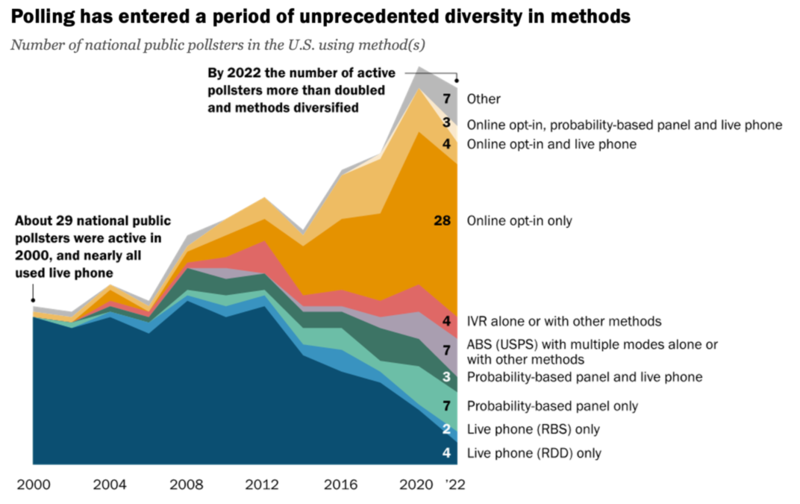

In light of this finding, the Pew Research Center reached the most radical operational conclusion: in 2022, the institution permanently abandoned outbound calls and shifted all of its U.S. surveys to its online panel panel A sample from which information is collected over time. It can be questioned several times at regular intervals. This method is pertinent for studying changes in behaviour. The sample can be questioned continuously: - either: each individual in the panel is asked to fill in a daily questionnaire relating to the subject of the study. This is the case for the Radio panel. - or the information is recorded and returned regularly. This is the case for the Médiamat panel. This method is pertinent for understanding behavioural patterns and their changes if the panel lasts long enough. Find out more (American Trends Panel). This decision, documented in *How Public Polling Has Changed in the 21st Century* (Pew, 2023), illustrates a constraint that forces stakeholders to abandon the probabilistic probabilistic The term probabilistic data refers to a process of identifying an individual based on a probabilistic model rather than on an identifier considered to be “infallible” thanks to its uniqueness. Find out more approach in favor of other methods.
This forced transition has had a paradoxical effect on the landscape of public opinion research. The abandonment of the RDD paradigm—a costly method that requires significant human resources and adheres to high standards of rigor—has significantly lowered the barriers to entry into the Survey Survey A statistical method that aims to produce information about a population by interviewing part of the population (sample). This word is generally used to mean a survey conducted on a sample that have been interviewed using a questionnaire or else systematically observed. Find out more market. Whereas conducting a representative representative A sample is said to be representative when it has been generated via a representative draw, meaning that each individual in the population had a non-zero probability of being selected. Representativeness relates to the sample and not to a unit of the population. It is not synonymous with a proportional sample or a "reduced model" of the population studied. In survey theory, it has been demonstrated that an optimal sampling strategy consists of organising the sample according to the variables that are most correlated to the subject of the study. Find out more telephone survey once required significant resources and a professional infrastructure, Opt-in Opt-in Opt-in marketing is a type of permission based marketing that involves using an opt-in process to confirm email addresses. Find out more online panels now allow new entrants to produce and publish results at a lower cost and, often, with less methodological rigor.
This proliferation sometimes fuels the perception that there are “too many surveys.” But this assessment deserves to be turned on its head: it is not the proliferation of surveys that is the problem in and of itself, but rather the gradual disappearance of the most robust method available—the random-digit-dialing telephone survey, based on a probabilistic sampling frame sampling frame List of individuals or statistical units forming a population within which one wishes to draw a sample, and from which the information required will be gathered. For example, the entire group of telephone subscribers may constitute the sampling frame of certain studies. Find out more covering the entire population population The universe of a survey composed of basic statistical units. These units may be physical persons, households, companies, municipalities, etc. The population serves as a sampling frame for selecting a sample, and as a basis for calculation of the extrapolations from the sample. Find out more —which creates a void that less rigorous methods come to fill. The apparent inflation in supply actually masks a decline in average average The average is one of the most important statistical indicators for a set of numbers. By default, it is the arithmetic mean, calculated by adding the values in the set and then dividing that sum by the number of values. Find out more quality, directly attributable to the erosion of telephone reachability, and which fosters the emergence of new players by lowering barriers to entry.
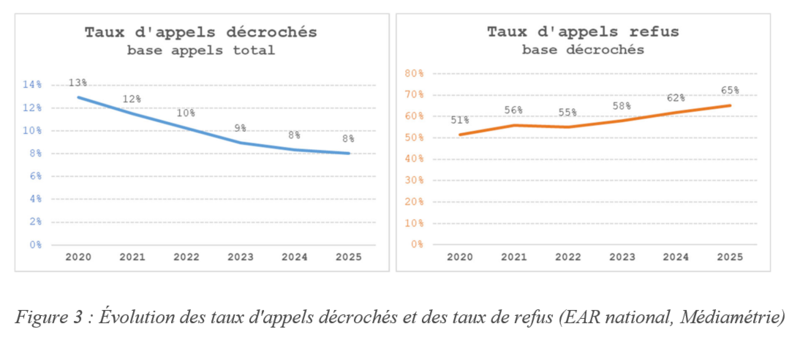
The fact that one of the world’s most rigorous and well-resourced survey organizations has deemed the telephone definitively unviable is, in itself, a particularly telling sign. It is against this backdrop of a deteriorating international landscape that the trends observed in France are taking place. Data Data Digital data Find out more from Médiamétrie’s national Radio Audience Audience The set of listeners, viewers, or TV viewers in which each individual is equally weighted, regardless of their listening/viewing duration or frequency of contact. Find out more Survey (EAR) illustrate a similar decline: answer rates have hit historic lows, while immediate refusals and calls hung up without explanation are rising steadily. The technical and economic feasibility of systems that constitute essential infrastructure for the media market is being directly called into question question An inquiry posed in the same way to all participants in the same survey, with the goal of obtaining answers of the same nature. We distinguish closed questions whose responses are chosen from the options provided (scales, yes / no, classification options, etc.), from open-ended questions for which no answer categories are offered. In the latter case, the spontaneous answer of the interviewee is gathered. Find out more , forcing the adoption of hybrid methods combining telephone surveys and panels to compensate for this deterioration.
3. The structural problem associated with Verified Multipurpose Numbers (NPV)
The reachability crisis includes a regulatory dimension, the effects of which are all the more paradoxical because they stem from a decision made with the legitimate goal of protecting users.
ARCEP ARCEP The Autorité de Régulation des Communications Électroniques et des Postes (Electronic and postal communications regulator) is an independent administrative authority that was created on 5 January 1997 as the ART – Autorité de Régulation des Télécommunications (Telecoms Regulatory Authority). ARCEP is the architect and guardian of exchange networks in France. It ensures that the market is open to new players and to all forms of innovation. ARCEP works alongside the public authorities to extend connectivity right across France and runs the framework for network interoperability. Find out more Decision No. 2022-1583, issued in September 2022 and effective as of January 1, 2023, prohibits the use of mobile numbers (06 and 07) and most geographic numbers (01 through 05) as caller IDs by automated calling systems, in order to protect users from large volumes of unsolicited calls and messages. To continue using automated or semi-automated Calling Systems—predictive or progressive dialers, which are the standard tools in field field All the operations that structure the work of interviewers: description of the interviewees, instructions for choosing the interviewees, quotas, administering the questionnaire, quality controls, etc. The entire physical system (rooms, personal computers, telephones, etc.) used for telephone surveys, and the related organisation is called the “telephone field”. Find out more call centers— organizations conducting surveys are now required to use Verified Multipurpose Numbers with predefined prefixes: 0162, 0163, 0270, 0271, 0377, 0378, 0424, 0425, 0568, 0569, 0948, 0949 for metropolitan France. This requirement applies regardless of the purpose of the calls, including official public Statistics Statistics Statistics or Data Science is a field of mathematics that studies phenomena through data collection, processing, analysis, graphical representation and visualisation (Data Visualisation), as well as the interpretation of results. Find out more surveys, provided they use automated systems.
The operational implications were analyzed in detail by Charrance, Cochet, and Merly-Alpa (NIDS) in a paper presented at the 13th Francophone Colloquium on Surveys in 2024 (“Telephone Surveys at NIDS NIDS National Institute of Demographic Studies Find out more : NPV or Not NPV?”, hal-04795028). Two main effects were identified. The first is behavioral: the predefined prefixes of NPV numbers make them easily recognizable by respondents, who overwhelmingly associate them with telemarketing and refuse to answer. The second is technical and more insidious: call-blocking systems built into smartphones or deployed by carriers intercept NPV calls before the phone even rings, making contact contact In media planning, a contact refers to an individual's exposure to an advertisement. In radio parlance, this is Opportunity to Hear (OTH) and for TV, Internet, press, cinema and poster advertisements, it is called Opportunity to See (OTS). Find out more literally impossible for a growing proportion of potential respondents.
To measure these effects, NIDS conducted an experiment in 2024 during the dry runs for the FamEmp and Erfi 2 surveys. A comparison of answer rates between calls made via NPV (semi-automatic mode mode In statistics, the mode is the most common value. Find out more ) and calls made to traditional multipurpose numbers (manual mode) yielded alarming results for landlines: the first-call answer rate was 21.7% for calls to traditional numbers, compared to only 5.7% for calls to NPVs, representing an unfavorable ratio of 1 to 4.
Market research and survey survey A statistical method that aims to produce information about a population by interviewing part of the population (sample). This word is generally used to mean a survey conducted on a sample that have been interviewed using a questionnaire or else systematically observed. Find out more firms, even when working on government contracts, cannot circumvent the NPV system if they use semi-automatic dialers and intend to comply with the law. The manual mode is significantly more expensive, as each call attempt must be coded individually by the interviewer. The regulation, designed to protect citizens from nuisance calls, thus imposes an indiscriminate burden on activities with radically different purposes, undermining the systems whose quality determines the representativeness of surveys serving the public interest.
Added to this fundamental paradox is an even more revealing observation from the Field. Even though NPV numbers are legal, duly assigned by ARCEP as part of the numbering plan and specifically designed for high-volume calls from automated systems, they are regularly blocked mid-session by operators, without any legal basis for doing so. The operational consequence is striking: it is rare for a single NPV number to be used without disruption for more than one consecutive hour in the field. Data Data Digital data Find out more collection service providers are therefore forced to constantly rotate a pool of NPV numbers, changing the calling number as soon as answer rates plummet. This forced rotation introduces heterogeneity in calling conditions within the same field survey—some respondents were contacted from a number that was still “clean,” while others from a number that is already partially or completely blocked—and the effects of this on the composition of the final sample sample A subset of the population studied, selected in accordance with a sampling plan, and subject to the collection of information. Find out more constitute an uncontrolled source of bias bias The bias of a statistical result is the difference between the result obtained and the exact value that one is seeking. There are three distinct types of bias: sampling bias (for example: using an unsuitable sampling frame), observational bias (for example: poor wording of a question or answer grid), and estimate bias (for example: not fully taking into account the categories for drawing the sample). Find out more . The paradox is complete: survey firms find themselves adopting exactly the same number rotation strategy that regulators attribute to fraudulent actors, simply to preserve minimal access to their legitimate respondents.
4. The Act of June 30, 2025, and the Creation of the NPAIGs: Partial Recognition, Uncertain Implementation
The regulatory process initiated by the 2022 ARCEP ARCEP The Autorité de Régulation des Communications Électroniques et des Postes (Electronic and postal communications regulator) is an independent administrative authority that was created on 5 January 1997 as the ART – Autorité de Régulation des Télécommunications (Telecoms Regulatory Authority). ARCEP is the architect and guardian of exchange networks in France. It ensures that the market is open to new players and to all forms of innovation. ARCEP works alongside the public authorities to extend connectivity right across France and runs the framework for network interoperability. Find out more decision underwent a major legislative development in 2025, the effects of which on investigative practices are still being defined at the time of this communication.
The market research and survey survey A statistical method that aims to produce information about a population by interviewing part of the population (sample). This word is generally used to mean a survey conducted on a sample that have been interviewed using a questionnaire or else systematically observed. Find out more industry did not passively accept the classification of its activities as commercial solicitation. As early as 2022, SYNTEC SYNTEC Opinion and Marketing Research association with a membership of around 40 companies. The mission of its member companies is to supply their clients with the information required to make decisions. Find out more Conseil had filed a request with ARCEP to amend the numbering plan to exclude survey calls from the scope of the NPV requirement. Following the rejection of this request, a petition was filed with the Council of State, which dismissed it in a decision dated June 6, 2024, ruling that it had not been established that, from the perspective of consumer protection, Survey activities warranted separate treatment. This decision brought the litigation to a close and referred the issue back to the legislative arena.
It was during the parliamentary review of the bill aimed at banning unsolicited telemarketing without consent consent Any freely given, specific, informed and unambiguous indication of the data subject's wishes through which he or she, by a statement or by a clear affirmative action, signifies agreement to the processing of personal data relating to him or her. It is one of the six legal bases provided for by the GDPR. Find out more (National Assembly, November 2024) that the industry achieved a breakthrough in principle. Syntec Conseil proposed assigning polling organizations—identified on a closed, verifiable list—numbers distinct from those used for telemarketing, with their sole authorized activity being the conduct of surveys—excluding any telemarketing.
Law No. 2025-594 of June 30, 2025, against all forms of public aid fraud (known as the Cazenave Law) includes, in Article 16, a provision creating a specific category for automated calls and messages related to missions of general interest — the NPAIGs (Multipurpose Numbers for Calls and Messages of General Interest) —, which may only be assigned to entities designated by a joint order of the ministers responsible for consumer affairs and electronic communications. ARCEP implemented this legislative mandate in its Decision No. 2025-2215 of November 27, 2025, published on December 2, 2025, and effective as of January 1, 2026, which formally incorporates the NPAIG category into the national numbering plan.
The benefits of this system are real in theory: by assigning survey and survey calls numbers distinct from those used for commercial solicitation, it enables call-filtering systems and respondents to identify these calls as being in the public interest. However, as of the date of this communication (May 2026), the joint decree defining the list of entities authorized to use NPAIGs and the registration requirements has not yet been published. The legislative provision is in effect, but its operational applicability remains contingent upon the publication of this regulatory text.
Furthermore, even once the decree is published, two major uncertainties remain. The first is behavioral: there is no guarantee that numbers beginning with new, predefined prefixes will be answered more frequently than current NPVs, in a context where mistrust of any unknown number is structurally on the rise, as precisely demonstrated by the Médiamétrie Survey presented at this conference (Senaux & Le Sager, 2026). The second is technical: the AI filtering systems deployed by operators and smartphone manufacturers operate based on behavioral logic rather than regulatory categories. The effective inclusion of NPAIGs in the whitelists of these systems will require coordination with all stakeholders in the mobile ecosystem, the timelines for which are unpredictable. The law thus creates the conditions for differential treatment that the technology is not yet capable of guaranteeing.
5. The Architecture of Filtering Systems: A Three-Tiered Approach
To understand why NPVs have so dramatically worsened the reachability of telephone surveys, it is necessary to describe in detail the architecture of the call-filtering systems deployed in France, which operate at three distinct and cumulative levels—the carrier network, the terminal, and the third-party application layer—whose combination produces blocking effects significantly greater than what each layer would produce on its own.
5.1 First level: carrier filtering, at the network level
The four major French carriers — Orange, SFR, Bouygues Telecom, and Free — have each deployed anti-spam filtering services integrated into their network infrastructures, which can be activated by their subscribers or are natively included in certain plans. These services use traffic analysis and shared blacklists to filter filter A question allowing the selection of a subpopulation that is subject to a specific part of the questionnaire. Find out more out suspicious calls before they even reach reach Reach is the term used to describe the reach achieved by a medium, publication, advertisement or campaign. It corresponds to the number of users reached and is therefore quantitative data. Reach plays a key role in measuring return on investment. It is used to determine whether or not the communication is effective. Whether for a website or a social network, reach corresponds to the proportion of the Internet user population or the audience reached by the site or network over a set period. Find out more the user’s device. These systems operate using two main mechanisms: blacklists fed by subscriber reports (via the short code 33700 or reporting interfaces built into apps), and traffic behavioral analysis algorithms that detect patterns characteristic of automated activity—a high volume of calls from a single number over a short period, a high rate of unanswered or short-duration calls, and a regular timing pattern suggestive of a dialer.
It is this second mechanism that indiscriminately targets the numbers used by survey survey A statistical method that aims to produce information about a population by interviewing part of the population (sample). This word is generally used to mean a survey conducted on a sample that have been interviewed using a questionnaire or else systematically observed. Find out more firms: by design, a telephone survey campaign generates exactly the behavioral signals that these algorithms are trained to identify as spam. Fields conducted in a progressive semi-automated mode mode In statistics, the mode is the most common value. Find out more structurally generate high daily volumes and a non-answer rate that, in the current context of increasing selectivity, can easily exceed 70 to 80 percent of attempts. The algorithm cannot distinguish between a call center conducting intensive telemarketing and a scientific survey conducted according to established rules: both produce the same outgoing traffic profile.
5.2 Second level: Native device filtering
Independent of carrier services, the iOS and Android operating systems have integrated increasingly sophisticated filtering features into their call-handling layers. Since iOS 13 (2019), the iPhone has offered the “Silence Unknown Callers” feature, which uses Siri’s intelligence to detect “known” numbers " (saved contacts, recently dialed numbers, numbers appearing in emails or messages) and silently routes the others to voicemail without the device ringing. The determining criterion criterion A computer or statistical object that groups the same information for all individuals in the study population. For example, the AGE variable represents the age of all the individuals of the population studied. Variables can be qualitative (e.g., GENDER or SPG) or quantitative (e.g., AGE or HEIGHT). Find out more is binary: either the calling number is “known” or it is not—and NPVs, by definition, will never appear in the contact contact In media planning, a contact refers to an individual's exposure to an advertisement. In radio parlance, this is Opportunity to Hear (OTH) and for TV, Internet, press, cinema and poster advertisements, it is called Opportunity to See (OTS). Find out more list of a respondent who is unfamiliar with the survey organization.
This phenomenon is accelerating with newer versions: iOS 18 introduced an even more aggressive version of filtering, in which the caller’s voice is converted to text that the user reads on their screen before deciding whether to answer the call. For fields using a progressive dialer, this mechanism is particularly devastating: the connection delay of a few seconds between the moment a respondent accepts and the moment the interviewer picks up the call can be interpreted by the filtering algorithms as a signature signature An electronic code inserted into a digital or analogue signal, making it possible to authenticate the transmitting source. Find out more of an automated call, leading to the call being blocked before a conversation can even begin.
5.3 Third Level: Community-based third-party apps
The most dynamic layer consists of third-party number-scoring apps: Truecaller (over 450 million users worldwide), Hiya (natively integrated into Samsung smartphones and used as a flagging engine by several carriers), or Should I Answer. These apps operate on the principle of a collaborative database database All the homogeneous data collected over the course of several surveys and whose structure provides the potential for tailor-made consultations and inquiries. Find out more : a low threshold of reports—around 10 to 15 per week—is enough to flag a number as high-risk. The critical threshold for triggering automatic spam flagging is around 250 to 300 outbound calls per day from a single number. For a standard-sized field field All the operations that structure the work of interviewers: description of the interviewees, instructions for choosing the interviewees, quotas, administering the questionnaire, quality controls, etc. The entire physical system (rooms, personal computers, telephones, etc.) used for telephone surveys, and the related organisation is called the “telephone field”. Find out more survey involving multiple interviewers working within the same NPV range, this threshold is easily reached. Furthermore, if more than 30% of calls last less than 10 seconds—which is the case with unanswered calls and immediate hang-ups, common in current field investigations—the robocall pattern is automatically detected. Once flagged as high-risk, a number requires a complete two- to four-week hiatus to be reinstated, with no possible shortcuts.
5.4 The Paradox of Penalized Regulatory Compliance
The architecture described above creates a paradox of unprecedented severity: the players who scrupulously comply with the regulatory framework—by using NPVs in accordance with ARCEP ARCEP The Autorité de Régulation des Communications Électroniques et des Postes (Electronic and postal communications regulator) is an independent administrative authority that was created on 5 January 1997 as the ART – Autorité de Régulation des Télécommunications (Telecoms Regulatory Authority). ARCEP is the architect and guardian of exchange networks in France. It ensures that the market is open to new players and to all forms of innovation. ARCEP works alongside the public authorities to extend connectivity right across France and runs the framework for network interoperability. Find out more Decision No. 2022-1583—are precisely the ones that filtering systems target target A subset of the population which we aim to reach with a show or advertising campaign. The target is defined using socio-demographic, equipment, or behavioural characteristics. Find out more and penalize most effectively. A survey firm that faithfully displays its identifiable NPV number is immediately categorized by filtering systems within the same numbering range as telemarketing. Regulatory compliance is doubly penalizing ICI: it makes the number identifiable and therefore avoidable, and it generates traffic patterns (volume, non-answer rate) that feed the filtering algorithms.
The industry’s hope is that, once operational, NPAIGs will be treated differently in operators’ databases and in the algorithms of third-party platforms. This hope, however, faces a structural limitation: the filtering systems of Truecaller, Hiya, Apple, or telecom operators are private systems, deployed according to their own commercial and security logic, including algorithms that are not public and which have no legal obligation to align their scoring rules with ARCEP’s regulatory classifications. The necessary coordination between the national regulator, French telecom operators, device manufacturers, and international scoring platforms presents a challenge whose complexity far exceeds the regulatory timeline associated with the publication of the NPAIG decree.
6. Beyond NPVs: The European Regulatory Threat to Independent Audience Measurement
The regulatory tensions described so far mainly concern the method of contacting respondents. Another tension, more specific to Media Audience Measurement Audience Measurement Quantitative study of the frequency of use of media. Find out more , is worth noting, given the profound implications at stake.
The body of European regulations currently under negotiation or in effect — the Digital Digital A signal is said to be digital if it can be represented by a series of discrete values that can be coded in binary as either 0 or 1. It is the opposite of analogue signal. Digital broadcasting has become the primary mode for television broadcasting, whether by cable, satellite, or even terrestrial. Find out more Omnibus Omnibus A survey carried out regularly for a group of clients, each of which has the exclusive rights to the results of questions they individually asked. These questions can relate to diverse areas. Find out more — stems from a harmful conflation of two fundamentally distinct activities: independent Audience Measurement and Targeting Targeting An action to define or create a target. Find out more . By equating—both in its underlying logic and in its operational categories—the collection of data data Digital data Find out more for representative representative A sample is said to be representative when it has been generated via a representative draw, meaning that each individual in the population had a non-zero probability of being selected. Representativeness relates to the sample and not to a unit of the population. It is not synonymous with a proportional sample or a "reduced model" of the population studied. In survey theory, it has been demonstrated that an optimal sampling strategy consists of organising the sample according to the variables that are most correlated to the subject of the study. Find out more measurement purposes with the use of personal data personal data Means any information relating to an identified or identifiable natural person (hereinafter the ‘data subject’); an identifiable natural person is one who can be identified, directly or indirectly, in particular by reference to an identifier such as a name, an identification number, location data, an online identifier or to one or more factors specific to the physical, physiological, genetic, mental, economic, cultural or social identity of that natural person. Find out more for commercial targeting, this framework risks imposing on independent audience measurement organizations — Médiamétrie in France, and its counterparts in other Member States — Consent Consent Any freely given, specific, informed and unambiguous indication of the data subject's wishes through which he or she, by a statement or by a clear affirmative action, signifies agreement to the processing of personal data relating to him or her. It is one of the six legal bases provided for by the GDPR. Find out more and Anonymisation Anonymisation A processing method that consists, for example, of the irreversible encryption of personal data, in such a way as to make it impossible to identify the person from the data. Find out more requirements designed for advertising platforms, not for statistical panel panel A sample from which information is collected over time. It can be questioned several times at regular intervals. This method is pertinent for studying changes in behaviour. The sample can be questioned continuously: - either: each individual in the panel is asked to fill in a daily questionnaire relating to the subject of the study. This is the case for the Radio panel. - or the information is recorded and returned regularly. This is the case for the Médiamat panel. This method is pertinent for understanding behavioural patterns and their changes if the panel lasts long enough. Find out more surveys.
The paradox is staggering: through an uncontrolled application of the complexity of the GDPR GDPR Regulation (EU) 2016/679 of the European Parliament and of the Council of 27 April 2016 on the protection of natural persons with regard to the processing of personal data and on the free movement of such data, and repealing Directive 95/46/EC. The General Data Protection Regulation gives European citizens back control of their personal data. Entered into force in the EU on 25 May 2018, the GDPR imposes limits on companies with regard to the collection and processing of data belonging to their users or customers. Find out more and its sector-specific implementing regulations, we could end up in a situation where only the major international platforms — Google, Meta, Amazon, Netflix — would be able to provide data on their own audiences, based on first-party data collected with Consent under their terms of service, while independent measurement organizations would be deprived of the tools necessary to fulfill this mission. Independent, transparent audience measurement certified by market participants would thus be replaced by with self-reported audience audience The set of listeners, viewers, or TV viewers in which each individual is equally weighted, regardless of their listening/viewing duration or frequency of contact. Find out more figures from the platforms themselves—a reversal that would undermine not only the balance of advertising markets but also the collective ability to obtain an accurate and verifiable picture of European citizens’ media consumption. This issue requires urgent attention from researchers, regulators, and Members of the European Parliament.
7. Key Points: What Not to Do, What to Do
7.1 Two Pitfalls to Avoid
Do not assume that the decline in reachability will level off. International data data Digital data Find out more and French observations both point to the same conclusion: there is no credible sign of a lasting plateau, much less a reversal of the trend. This trend is structural, driven by technological, behavioral, and regulatory dynamics, including none that show any signs of slowing down. The widespread adoption of AI in filtering systems, the intensification of awareness awareness Knowledge that a format (TV network, radio station, magazine), show, host, or brand exists. Spontaneous recall (in response to an open-ended question) is distinguished from aided recall (in response to a closed-ended question). Find out more campaigns about phone scams, and the continued decline of landline telephony are all factors that are likely to exacerbate the problem. Planning data collection mechanisms based on the assumption that the trend will stabilize would be like building on quicksand.
Do not succumb to the allure of synthetic data as a general solution. The rise of generative artificial intelligence has brought an old idea back into the spotlight: since it’s becoming difficult to survey survey A statistical method that aims to produce information about a population by interviewing part of the population (sample). This word is generally used to mean a survey conducted on a sample that have been interviewed using a questionnaire or else systematically observed. Find out more respondents, why not simulate them? Synthetic data undoubtedly has operational advantages—it allows for the completion completion The video completion rate is an important indicator used to assess the effectiveness of video advertising broadcast on digital media. It is measured in terms of the proportion of the audience that views a video in its entirety. The term is often used to designate the average proportion of a video viewed. For example, a video completion rate of 50% means that, on average, the video is viewed halfway through. Find out more of underrepresented subpopulations and reduces data collection costs. The work presented at this conference by Médiamétrie on the Métridom survey in Guyane (Dudoignon, Duprat, Raige-Verger & Salaün, 2026) provide a compelling illustration: the results obtained for Audience Audience The set of listeners, viewers, or TV viewers in which each individual is equally weighted, regardless of their listening/viewing duration or frequency of contact. Find out more Indicators are generally consistent with the original sample sample A subset of the population studied, selected in accordance with a sampling plan, and subject to the collection of information. Find out more , and initial accuracy assessments are encouraging. But the authors themselves emphasize that the approach is not yet conclusive—the question question An inquiry posed in the same way to all participants in the same survey, with the goal of obtaining answers of the same nature. We distinguish closed questions whose responses are chosen from the options provided (scales, yes / no, classification options, etc.), from open-ended questions for which no answer categories are offered. In the latter case, the spontaneous answer of the interviewee is gathered. Find out more of the variance variance The variance of a statistical distribution is the average of the squares of the differences between the values of the distribution and their average. A standard deviation is always determined by first finding the variance, then taking the square root. Find out more of estimators on augmented data and that of the stability of results from one wave to the next remain open. Yet this is precisely where the most serious risk lies. For some providers, the promise of synthetic data is primarily a response to economic and competitive pressures, rather than a methodologically validated solution. Adopting these approaches without a robust evaluation framework, without transparency regarding their limitations, and without collective reflection on their implications for the quality of the measurements produced would amount to substituting a semblance of a solution for a real problem. Public Statistics Statistics Statistics or Data Science is a field of mathematics that studies phenomena through data collection, processing, analysis, graphical representation and visualisation (Data Visualisation), as well as the interpretation of results. Find out more and Audience Measurement Audience Measurement Quantitative study of the frequency of use of media. Find out more cannot afford this shift.
7.2 Building a Collective and Political Response
The crisis of reachability will not be resolved by technical adjustments carried out in a scattered manner. It calls for a strategic, collective, and deliberately political response in the noble sense of the term—and this response first and foremost requires transcending a boundary that has long structured the sector: the one separating private and public actors in Statistics and audience measurement.
This distinction, often perpetuated by institutional and competitive dynamics, is no longer relevant in the face of a problem that affects them in the same way and simultaneously. Whether it is INSEE INSEE The Institut National de la Statistique et des Études Économiques (National Institute for Statistics and Economic Studies) is a general directorate of France's Ministry of the Economy, Finance, and Industry. INSEE carries out several sample surveys in the socio-economic field (households, companies), in addition to its responsibilities for the national accounts and taking the census (last completed in March 1999). This government agency is responsible for coordinating official statistics, reference data produced by the entire public statistics system. Find out more conducting its large-scale Household Household In the statistical sense of the term, a household refers to all occupants of the same dwelling, whether they are related or not. A household may be composed of a single person. Household populations therefore effectively exclude some communities (workers' hostels, retirement homes, university residences, prisons, etc.), the homeless, seamen and people living in mobile homes. Find out more Surveys, Médiamétrie producing its Audience Measurements, or private institutes conducting opinion surveys on behalf of ministries or local governments, it is one and the same activity that is at stake: the production of representative representative A sample is said to be representative when it has been generated via a representative draw, meaning that each individual in the population had a non-zero probability of being selected. Representativeness relates to the sample and not to a unit of the population. It is not synonymous with a proportional sample or a "reduced model" of the population studied. In survey theory, it has been demonstrated that an optimal sampling strategy consists of organising the sample according to the variables that are most correlated to the subject of the study. Find out more data on French society, which is essential for public decision-making and democratic debate. It is striking to note that the private polling sector operates largely on behalf of and for public entities—barometer surveys commissioned by government agencies, satisfaction satisfaction An area of study into consumer behaviour that aims to define the satisfaction or appreciation experienced by the user of a good, a product, or a service. Two complementary approaches are distinguished: understanding the process of forming satisfaction on one hand, and measuring the satisfaction on the other. Find out more surveys for Service Public services, and Audience Measurements for Service Public media. The institutional boundary is porous; the shared interests are real. In some European countries, better cooperation between public and private actors actually facilitates access to respondents without infringing on citizens’ privacy.
Speaking with one voice to administrative authorities and legislators, both national and European, is a necessity, not an option. The legal and political foundations for such an approach already exist. At the European level, the EMFA (European Media Freedom Act), adopted in 2024, explicitly recognizes in Article 24 the importance of transparent and comparable Audience Measurement as a condition for the proper functioning of the media market and pluralism of information. This landmark recognition—through which the European legislature affirms the public interest nature of Audience Measurement, unambiguously distinguishing it from any ordinary commercial purpose—constitutes a valuable tool for advocating with national regulators, and first and foremost with ARCEP ARCEP The Autorité de Régulation des Communications Électroniques et des Postes (Electronic and postal communications regulator) is an independent administrative authority that was created on 5 January 1997 as the ART – Autorité de Régulation des Télécommunications (Telecoms Regulatory Authority). ARCEP is the architect and guardian of exchange networks in France. It ensures that the market is open to new players and to all forms of innovation. ARCEP works alongside the public authorities to extend connectivity right across France and runs the framework for network interoperability. Find out more , for differentiated treatment of phone numbers used for statistical surveys. At the national level, the industry also has encouraging precedents: exemptions have already been obtained under the NPAIG framework, demonstrating that dialogue with the regulator is possible when it is conducted consistently and in solidarity by all stakeholders.
However, this institutional recognition will only be sustainable if it is accompanied by ongoing efforts to distinguish and legitimize the practice in the public sphere. The growing tendency—in the minds of both the public and regulators—to conflate survey calls with telemarketing calls is one of the most serious obstacles to reachability. It is up to the profession to distinguish itself from this as clearly as possible—in its practices, in its public communications, and in its positions vis-à-vis public authorities. This means upholding strict ethical and methodological standards, rejecting any confusion between statistical measurement and commercial prospecting, and asserting with conviction—backed by data and regulatory texts—the irreplaceable role that the production of representative data plays in understanding society, the evaluation of public policies, and the functioning of democratic debate.
Reachability is not just a fieldwork issue. It is a societal issue—and it must be addressed as such.
Bibliography
ARCEP ARCEP The Autorité de Régulation des Communications Électroniques et des Postes (Electronic and postal communications regulator) is an independent administrative authority that was created on 5 January 1997 as the ART – Autorité de Régulation des Télécommunications (Telecoms Regulatory Authority). ARCEP is the architect and guardian of exchange networks in France. It ensures that the market is open to new players and to all forms of innovation. ARCEP works alongside the public authorities to extend connectivity right across France and runs the framework for network interoperability. Find out more Decisions and Documents
ARCEP (2019). Decision No. 2019-0954 amending Decision No. 2018-0881 establishing the national numbering plan and its management rules, and including measures to combat unsolicited calls and messages. https https This is the secure version of HTTP (Hypertext Transfer Protocol). In general, it is used for internet financial transactions such as online bookings, online banking, etc that involves a card payment. Find out more ://www.arcep.fr/uploads/tx_gsavis/19-0954.pdf
ARCEP (2022). Decision No. 2022-1583 of September 5, 2022, modernizing the framework for the allocation and use of numbering resources. https://www.arcep.fr
ARCEP (2025). Decision No. 2025-2215 of November 27, 2025, amending the national numbering plan. https://www.arcep.fr/uploads/tx_gsavis/25-2215.pdf
ARCEP (2025). Annual Survey Survey A statistical method that aims to produce information about a population by interviewing part of the population (sample). This word is generally used to mean a survey conducted on a sample that have been interviewed using a questionnaire or else systematically observed. Find out more of User Satisfaction Satisfaction An area of study into consumer behaviour that aims to define the satisfaction or appreciation experienced by the user of a good, a product, or a service. Two complementary approaches are distinguished: understanding the process of forming satisfaction on one hand, and measuring the satisfaction on the other. Find out more with Mobile Operators and Internet Service Providers, 2025 Edition. https://www.arcep.fr
Court Decisions
Council of State (June 6, 2024). Decision rejecting SYNTEC SYNTEC Opinion and Marketing Research association with a membership of around 40 companies. The mission of its member companies is to supply their clients with the information required to make decisions. Find out more Conseil’s petition regarding the exclusion of opinion polls and surveys from the NPV system. https://www.arcep.fr/actualites/actualites-et-communiques/detail/n/numerotation-plan-numerotation-130624.html
Parliamentary Proceedings
National Assembly (2025). Legislative File — Bill on Consent Consent Any freely given, specific, informed and unambiguous indication of the data subject's wishes through which he or she, by a statement or by a clear affirmative action, signifies agreement to the processing of personal data relating to him or her. It is one of the six legal bases provided for by the GDPR. Find out more -Based Telemarketing. https://www.legifrance.gouv.fr/dossierlegislatif/JORFDOLE000050500285/
National Assembly (February 14, 2025). Amendment No. CE14 introduced by Ms. Batho, Mr. Tavernier, and Mr. Fournier to Bill No. 561. https://www.assemblee-nationale.fr/dyn/17/amendements/0561/CION-ECO/CE14.pdf
French Republic (2025). Law No. 2025-594 of June 30, 2025, against all forms of fraud involving public aid (Article 16 — NPAIG). Official Journal.
Institutional Reports
Mouton, S. & Cyrulnik, B. (co-chairs) (2024). Children and Screens: Report of the Commission on Children and Screens. Report submitted to the Office of the President of the Republic, April 2024. Paris: Élysée.
Methodological Sources and Reference Studies
Charrance, G., Cochet, A. & Merly-Alpa, F. (2024). Telephone Surveys at NIDS NIDS National Institute of Demographic Studies Find out more : NPV or Not NPV? Paper presented at the 13th Francophone Colloquium on Surveys. HAL: hal-04795028.
Dudoignon, L., Duprat, L., Raige-Verger, J., & Salaün, N. (2026). Synthetic Data Data Digital data Find out more and Improved Accuracy: Tests on an Audience Measurement Audience Measurement Quantitative study of the frequency of use of media. Find out more Survey. Paper presented at the 14th Francophone Symposium on Surveys, Vannes.
Médiamétrie (2025). Equipment Barometer Barometer By analogy with meteorology, this term designates any regular measurement that can give an account of changes in audience, opinion, image, etc. Find out more , 2025 data. Paris: Médiamétrie.
Pew Research Center (2012). Assessing the Representativeness of Public Opinion Surveys. https://www.pewresearch.org/politics/2012/05/15/assessing-the-representativeness-of-public-opinion-surveys/
Pew Research Center (2017). What Low Response Rates Mean for Telephone Surveys. https://www.pewresearch.org/methods/2017/05/15/what-low-response-rates-mean-for-telephone-surveys/
Pew Research Center (2019). Phone Survey Response Rates Decline Again. https://www.pewresearch.org/short-reads/2019/02/27/response-rates-in-telephone-surveys-have-resumed-their-decline/
Pew Research Center (2023). How Public Polling Has Changed in the 21st Century. https://www.pewresearch.org/methods/2023/04/19/how-public-polling-has-changed-in-the-21st-century/