
Smart TV Barometer, 1st Half of 2026: Understanding New Usage Patterns to Better Anticipate Market Trends
Smart TVs have become a must-have in French households. With more than 9 out of 10 households owning one, access to video content is changing: Smart TVs, Streaming Streaming A technical method of digitally transmitting data to enable the playback of a continuous flow of video and audio material. Unlike terrestrial or satellite TV broadcasting, this technology requires a two-way network (internet) to send periodic requests to the streaming server in order to receive video or audio micro-files. Find out more , Catch-up TV Catch-up TV This refers to the TV viewing modes whereby a programme is watched on demand after its live broadcast. See Watch again, Catch-up, Time-shifted viewing. Find out more , live TV, and on-demand platforms are reshaping how people use TV. The Smart TV Smart TV Televisions connected directly (Smart TV) or indirectly (via an operator's box, a connected device such as Apple TV/Chromecast or a games console) to the internet, enabling access to streaming applications in particular. Find out more Barometer Barometer By analogy with meteorology, this term designates any regular measurement that can give an account of changes in audience, opinion, image, etc. Find out more breaks down the key trends.
How Will the French Watch TV in 2026? Why do more than 9 out of 10 households now have a Smart TV Smart TV Televisions connected directly (Smart TV) or indirectly (via an operator's box, a connected device such as Apple TV/Chromecast or a games console) to the internet, enabling access to streaming applications in particular. Find out more ? Discover the major trends transforming how people use their TVs and the growing role of Smart TVs in the daily lives of the French

Smart TV: A Must-Have Device
Smart TVs continue to grow in popularity and have now become a central piece of equipment in the household household In the statistical sense of the term, a household refers to all occupants of the same dwelling, whether they are related or not. A household may be composed of a single person. Household populations therefore effectively exclude some communities (workers' hostels, retirement homes, university residences, prisons, etc.), the homeless, seamen and people living in mobile homes. Find out more . More than 90% of households with a television now own a Smart TV Smart TV Televisions connected directly (Smart TV) or indirectly (via an operator's box, a connected device such as Apple TV/Chromecast or a games console) to the internet, enabling access to streaming applications in particular. Find out more , reflecting the widespread adoption of these technologies and their growing role in everyday life.
The goal of this new edition of the Smart TV Barometer Barometer By analogy with meteorology, this term designates any regular measurement that can give an account of changes in audience, opinion, image, etc. Find out more is to better understand how French consumers are equipping their homes, the solutions they use to access content, and the new habits emerging on the big screen. The study study Any research done across a population, line of business, or products (programme content, programme schedules, etc.) A study relies most often on the data coming out of a survey (or surveys). Find out more highlights the gradual transformation of the television into a true digital digital A signal is said to be digital if it can be represented by a series of discrete values that can be coded in binary as either 0 or 1. It is the opposite of analogue signal. Digital broadcasting has become the primary mode for television broadcasting, whether by cable, satellite, or even terrestrial. Find out more entertainment platform
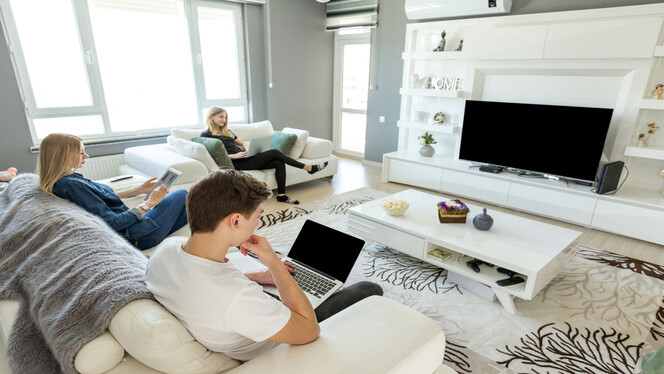
Smart TVs are emerging as a gateway to content
While ISP set-top boxes remain the primary way to access television, Smart TVs are steadily gaining ground. Their success stems from their ability to bring together various services—ranging from live TV to
Streaming
Streaming
A technical method of digitally transmitting data to enable the playback of a continuous flow of video and audio material. Unlike terrestrial or satellite TV broadcasting, this technology requires a two-way network (internet) to send periodic requests to the streaming server in order to receive video or audio micro-files.
Find out more
platforms and numerous apps—within a single interface.
This development reflects a fundamental trend: French consumers are seeking more seamless experiences and simplified access to all their content, directly from their TV.
Smart TVs are emerging as a gateway to content
While ISP set-top boxes remain the primary way to access television, Smart TVs are steadily gaining
field
field
All the operations that structure the work of interviewers: description of the interviewees, instructions for choosing the interviewees, quotas, administering the questionnaire, quality controls, etc. The entire physical system (rooms, personal computers, telephones, etc.) used for telephone surveys, and the related organisation is called the “telephone field”.
Find out more
. Their success stems from their ability to centralize various services—ranging from live TV to
Streaming
Streaming
A technical method of digitally transmitting data to enable the playback of a continuous flow of video and audio material. Unlike terrestrial or satellite TV broadcasting, this technology requires a two-way network (internet) to send periodic requests to the streaming server in order to receive video or audio micro-files.
Find out more
platforms and numerous apps—within a single interface.
This development reflects a fundamental trend: French consumers are seeking more seamless experiences and simplified access to all their content, directly from their TV.
Streaming, catch-up viewing: ever-more-diverse uses
Live television continues to play a significant role in viewing habits, remaining the most common and most frequently used form of viewing. At the same time, on-demand services continue to grow, including
Catch-up TV
Catch-up TV
This refers to the TV viewing modes whereby a programme is watched on demand after its live broadcast. See Watch again, Catch-up, Time-shifted viewing.
Find out more
,
streaming
streaming
A technical method of digitally transmitting data to enable the playback of a continuous flow of video and audio material. Unlike terrestrial or satellite TV broadcasting, this technology requires a two-way network (internet) to send periodic requests to the streaming server in order to receive video or audio micro-files.
Find out more
platforms, and online videos.
Beyond traditional programming, smart TVs also provide access to a wide range of services: video on demand, music, personal content, and entertainment apps. This diversification of uses confirms the central role of the big screen in the
Household
Household
In the statistical sense of the term, a household refers to all occupants of the same dwelling, whether they are related or not. A household may be composed of a single person. Household populations therefore effectively exclude some communities (workers' hostels, retirement homes, university residences, prisons, etc.), the homeless, seamen and people living in mobile homes.
Find out more
’s
digital
digital
A signal is said to be digital if it can be represented by a series of discrete values that can be coded in binary as either 0 or 1. It is the opposite of analogue signal. Digital broadcasting has become the primary mode for television broadcasting, whether by cable, satellite, or even terrestrial.
Find out more
ecosystem.
A Major Challenge for Media and Advertising Professionals
The rise of
Smart TV
Smart TV
Televisions connected directly (Smart TV) or indirectly (via an operator's box, a connected device such as Apple TV/Chromecast or a games console) to the internet, enabling access to streaming applications in particular.
Find out more
is driving the
convergence
convergence
Coming together of domains or applications linked with technologies based on similar functions. Thus, the emergence and increased commonality of the digital signal allow for the convergence of the audio-visual, consumer electronics, computing, and telecommunications sectors.
Find out more
between the worlds of television and
digital
digital
A signal is said to be digital if it can be represented by a series of discrete values that can be coded in binary as either 0 or 1. It is the opposite of analogue signal. Digital broadcasting has become the primary mode for television broadcasting, whether by cable, satellite, or even terrestrial.
Find out more
media. Thanks to its high
penetration
penetration
The percentage of consumers of a media or the percentage of people reached by an advertising campaign. A penetration rate may relate to the entire reference population or to a part of it, that is defined using socio-demographic, economic, or behavioural characteristics.
Find out more
in households and the diversity of accessible content, it offers new opportunities for publishers, platforms, and advertisers to
reach
reach
Reach is the term used to describe the reach achieved by a medium, publication, advertisement or campaign. It corresponds to the number of users reached and is therefore quantitative data. Reach plays a key role in measuring return on investment. It is used to determine whether or not the communication is effective. Whether for a website or a social network, reach corresponds to the proportion of the Internet user population or the audience reached by the site or network over a set period.
Find out more
their audiences in a premium environment.
Understanding how Smart TV is used is therefore becoming a strategic priority for anticipating market trends and meeting the expectations of users who are increasingly connected.
A Sustainable Shift in Consumption Habits
The Barometer Barometer By analogy with meteorology, this term designates any regular measurement that can give an account of changes in audience, opinion, image, etc. Find out more ’s findings confirm a lasting trend: the television is no longer limited to broadcasting Linear Linear This is when a live television program is watched exactly at the time it airs, in timeshifting (control over live TV) or private delay (personal recording). Find out more programming. With the rise of Smart TVs, the growth of Streaming Streaming A technical method of digitally transmitting data to enable the playback of a continuous flow of video and audio material. Unlike terrestrial or satellite TV broadcasting, this technology requires a two-way network (internet) to send periodic requests to the streaming server in order to receive video or audio micro-files. Find out more , and the proliferation of services available on the big screen, Smart TV Smart TV Televisions connected directly (Smart TV) or indirectly (via an operator's box, a connected device such as Apple TV/Chromecast or a games console) to the internet, enabling access to streaming applications in particular. Find out more is establishing itself as the focal point for French consumers’ audiovisual and digital digital A signal is said to be digital if it can be represented by a series of discrete values that can be coded in binary as either 0 or 1. It is the opposite of analogue signal. Digital broadcasting has become the primary mode for television broadcasting, whether by cable, satellite, or even terrestrial. Find out more activities.
- How is Smart TV Smart TV Televisions connected directly (Smart TV) or indirectly (via an operator's box, a connected device such as Apple TV/Chromecast or a games console) to the internet, enabling access to streaming applications in particular. Find out more changing the way French people use it?
- Which brands and technologies currently dominate the market for Smart TVs and connected devices?
- What are the typical profiles of Smart TV users, and how do usage patterns vary by age,
Household
Household
In the statistical sense of the term, a household refers to all occupants of the same dwelling, whether they are related or not. A household may be composed of a single person. Household populations therefore effectively exclude some communities (workers' hostels, retirement homes, university residences, prisons, etc.), the homeless, seamen and people living in mobile homes.
Find out more
, or connection type?
The Smart TV Barometer Barometer By analogy with meteorology, this term designates any regular measurement that can give an account of changes in audience, opinion, image, etc. Find out more helps you analyze major market trends, understand how French consumers are using these devices in new ways, and identify the dynamics that are transforming the television viewing experience.
Would you like to receive detailed data data Digital data Find out more , exclusive analyses, or learn more about this Barometer?