
French Drama: Still the Leading Genre... and Now Master of Time
In line with the evolution of Médiamétrie’s brand brand Brand is the “brand” level. A brand is a set of URLs which are identified by the same logo. A brand is a coherent ensemble from the user viewpoint, in particular given the graphic charter or brand universe. Find out more universe universe All the statistical units from which a survey sample is drawn. When these units are people, the universe is termed a population. Find out more , Audience Audience The set of listeners, viewers, or TV viewers in which each individual is equally weighted, regardless of their listening/viewing duration or frequency of contact. Find out more le Mag is becoming M Insights, Le dossier.
M Insights, Le dossier is a monthly in-depth article based on the results of our studies, analyses, and expertise to provide an ever-more-detailed understanding of market trends, as well as insight into and analysis of the changing media behaviors of the French.
As the 2025 La Rochelle Fiction Festival approaches, one thing is clear: fiction (series and stand-alone episodes), particularly French fiction, not only dominates Prime time Prime time The section of the programme schedule covering the “main show” of the evening, which also corresponds to the time slot with the highest television audience. In France, prime time falls in the morning before 9am for radio, and in the early evening for television, generally between 8:50pm and 10:30pm. Find out more but is also establishing itself as the genre that best capitalizes on the revolution in viewing habits. From live broadcasts, Catch-up Catch-up Catch-up technology allows TV viewers to watch or rewatch a television programme after it has been broadcast live. Find out more , Previews, and recordings to streaming streaming A technical method of digitally transmitting data to enable the playback of a continuous flow of video and audio material. Unlike terrestrial or satellite TV broadcasting, this technology requires a two-way network (internet) to send periodic requests to the streaming server in order to receive video or audio micro-files. Find out more platforms, it reaches TV Viewers wherever they are… and whenever they want.

An Unbeatable Genre on Television
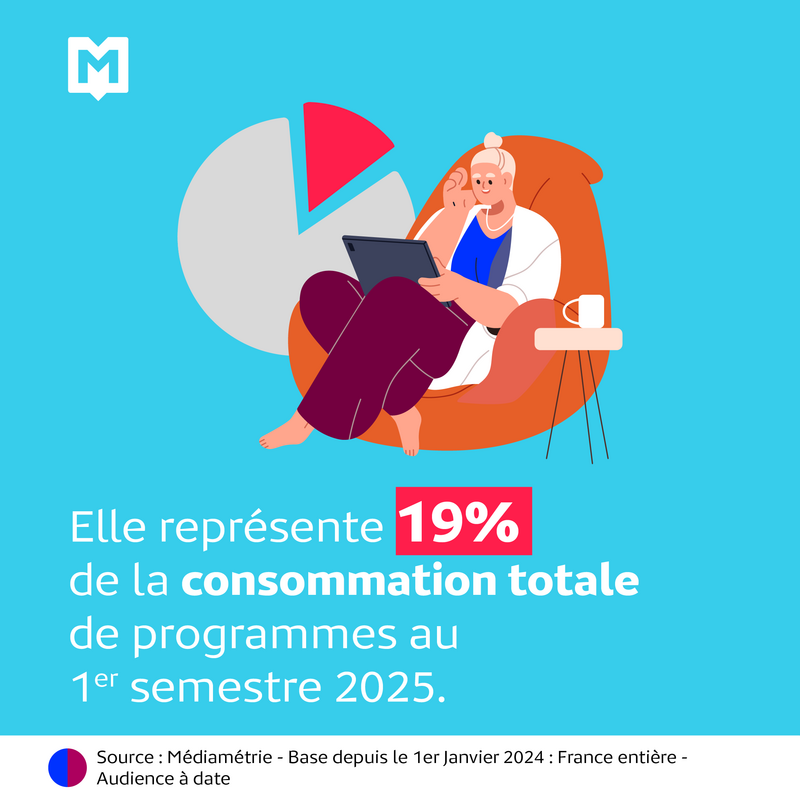
In the first half of 2025, drama accounted for 19% of total television viewing, just behind talk shows (20%) and ahead of news and game shows. It occupies 18% of the Programme Schedule Programme Schedule The distribution, generally over one week, of the different programmes by named day and time. We can draw a distinction between horizontal programming (the same show on every day at the same time) and vertical programming (the same shows by a particular day, e.g., the Sunday night movie). Find out more throughout the day. During prime time prime time The section of the programme schedule covering the “main show” of the evening, which also corresponds to the time slot with the highest television audience. In France, prime time falls in the morning before 9am for radio, and in the early evening for television, generally between 8:50pm and 10:30pm. Find out more (9:00 p.m.–11:00 p.m.), fiction takes on even greater prominence: it accounts for 21% of the Programme Schedule and nearly 1 in 3 programs watched.
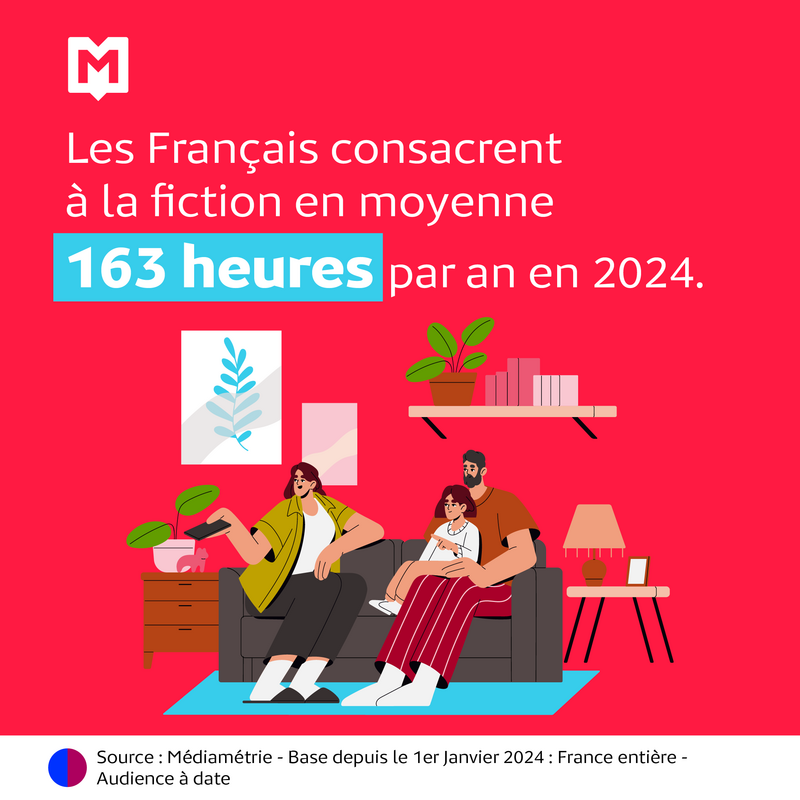
In 2024, the French spend an average of 163 hours per year watching fiction—proof that this viewing time remains a key moment for discovering or revisiting stories, Universes and characters.
The delinearised, a new ally for fiction
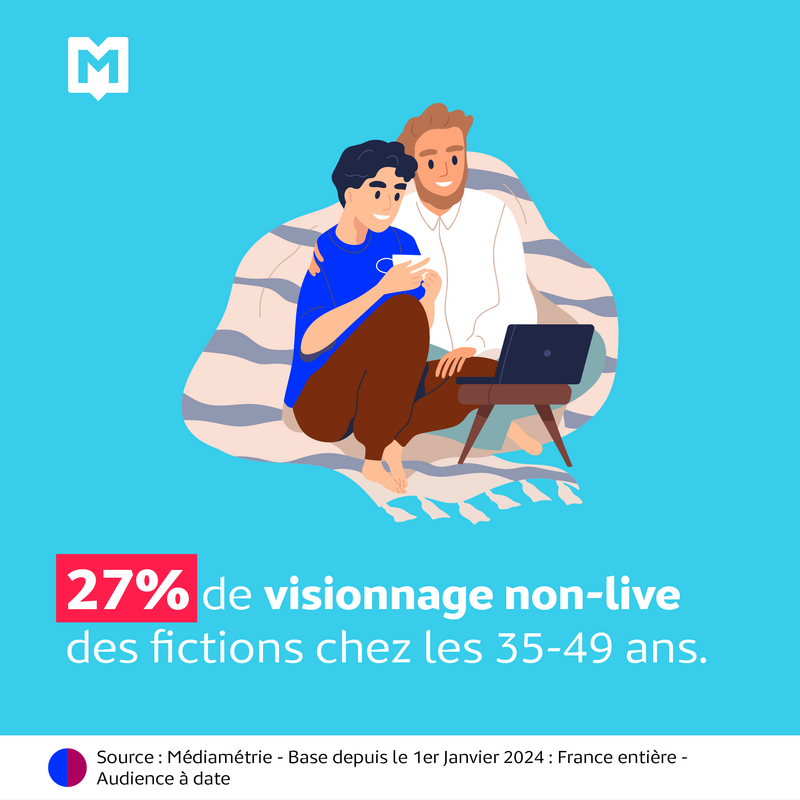
While live viewing remains central, we’re seeing a rise in “non-live” viewing—Previews, Catch-up Catch-up Catch-up technology allows TV viewers to watch or rewatch a television programme after it has been broadcast live. Find out more , personal recordings, and Control over live broadcasts—which is transforming the way people discover and follow fiction programming. In the first half of 2025, 13% of the fiction audience audience The set of listeners, viewers, or TV viewers in which each individual is equally weighted, regardless of their listening/viewing duration or frequency of contact. Find out more came from non-live viewing, a figure that reaches 19% during Prime time Prime time The section of the programme schedule covering the “main show” of the evening, which also corresponds to the time slot with the highest television audience. In France, prime time falls in the morning before 9am for radio, and in the early evening for television, generally between 8:50pm and 10:30pm. Find out more (9:15 p.m.–10:50 p.m.) and as high as 27% among 35- to 49-year-olds.
For some programs, non-live viewing even surpasses live viewing:
- Rivages (France.tv – Jan. 6–Jan. 20): 51% of viewership via Catch-up within 28 days of the Broadcast live (Day 28) + Preview Preview A way to view a television programme via a catch-up platform before it is broadcast on live TV. Find out more , for 4.2 million TV Viewers
- Despicable Me (CANAL + - 02/14): 88% of viewership via Catch-up on Day 28 + Preview,
- Vigil (ARTE – Jan. 9–Jan. 30): 62% of viewership split between Catch-up on Day 28 and Preview.
These figures reflect a profound shift: fiction is no longer tied to a fixed schedule; it circulates freely between Linear,
Catch-up
Catch-up
Catch-up technology allows TV viewers to watch or rewatch a television programme after it has been broadcast live.
Find out more
,
Preview
Preview
A way to view a television programme via a catch-up platform before it is broadcast on live TV.
Find out more
, recording, and platforms. This flexibility works in its favor, strengthening its long-term presence and broadening its
audience
audience
The set of listeners, viewers, or TV viewers in which each individual is equally weighted, regardless of their listening/viewing duration or frequency of contact.
Find out more
. Viewership is now built up over several days, or even several weeks. Drama has become long-form content, capable of accumulating a total audience far greater than its performance on the premiere night.
Major
prime time
prime time
The section of the programme schedule covering the “main show” of the evening, which also corresponds to the time slot with the highest television audience. In France, prime time falls in the morning before 9am for radio, and in the early evening for television, generally between 8:50pm and 10:30pm.
Find out more
events, however, continue to deliver impressive results: “HPI” on TF1 on May 15 with 7.8 million TV Viewers and a 38.3%
audience share
audience share
The audience share, or market share of an event (programme, advertising slot, channel, station, etc.) is the ratio of the average audience for that event and the average audience for the media over the same time slot. This gives an indicator of the relative performance of a channel or station relative to their competitors.
Find out more
; “Alex Hugo” on FRANCE 3 on May 20: 5.7 million TV Viewers and a 28.2% audience share, and Carpe Diem (5.5 million, 29%—on March 10 on TF1). As for 15- to 34-year-olds, they watch HPI more often as a Preview or on catch-up than live. Today, a show’s impact is measured as much by its post-broadcast performance as by its premiere night.
French Drama on the Rise
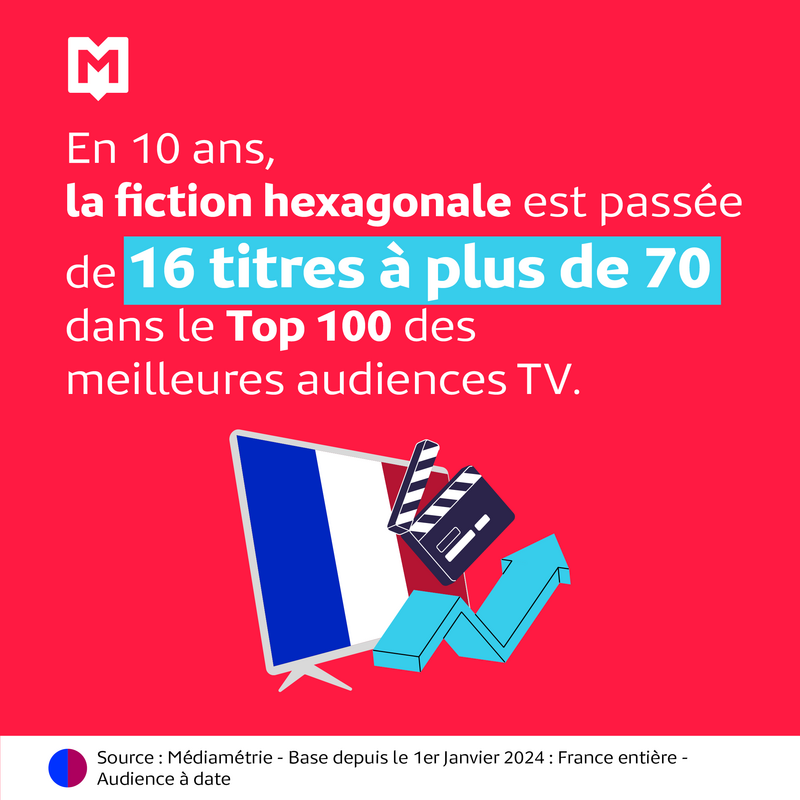
In ten years, French drama has gone from 16 titles in the top 100 highest-rated TV shows to more than 70 today. This shift reflects a leap in quality and greater exposure, but also the ability to create formats that transition seamlessly from live broadcasts to streaming streaming A technical method of digitally transmitting data to enable the playback of a continuous flow of video and audio material. Unlike terrestrial or satellite TV broadcasting, this technology requires a two-way network (internet) to send periodic requests to the streaming server in order to receive video or audio micro-files. Find out more platforms. This phenomenon is also evident internationally: an analysis of the top 10 Prime time dramas in 11 countries confirms the dominance of local dramas and, to a lesser extent, co-productions. Only Australia, Sweden, and Spain give greater prominence to imported series—British in the first two countries and Turkish in the third.
SVOD services, now required to invest in local production, offer an additional platform: about one-third of their content consists of French or European productions, including series that account for the lion’s share. French productions are gaining an increasingly prominent place on these platforms, expanding their
reach
reach
Reach is the term used to describe the reach achieved by a medium, publication, advertisement or campaign. It corresponds to the number of users reached and is therefore quantitative data. Reach plays a key role in measuring return on investment. It is used to determine whether or not the communication is effective. Whether for a website or a social network, reach corresponds to the proportion of the Internet user population or the audience reached by the site or network over a set period.
Find out more
beyond national borders. Their audiences—which are more fragmented—are beginning to be measured by Médiamétrie as part of the upcoming
Cross Media
Cross Media
Advertising and marketing practice that consists of using multiple media for a campaign. The objective of a cross media campaign is to play on the complementarity between the various media used. With this in mind, the aim of the Cross Media Advertising workshops set up by Médiamétrie is to work with the market to develop a new cross-media advertising measure (for TV and digital) to respond to rapidly changing uses and offers.
Find out more
video measurement initiative, which could lead to changes in editorial strategies. On SVOD platforms, fiction programming accounted for 75% of consumption in the first half of 2025.
French fiction is no longer limited to the competition between broadcasters and platforms. Co-productions between broadcasters and
streaming
streaming
A technical method of digitally transmitting data to enable the playback of a continuous flow of video and audio material. Unlike terrestrial or satellite TV broadcasting, this technology requires a two-way network (internet) to send periodic requests to the streaming server in order to receive video or audio micro-files.
Find out more
platforms are on the rise, such as Tout le Ciel Bleu between TF1 and Netflix, Belphégor between M6 and HBO Max, and Cœurs Noirs between Prime Video and France Télévisions: the two universes are collaborating through partnerships, such as those between TF1 and Netflix or France Télévisions and Prime Video, in particular. These alliances, which aim to
broadcast
broadcast
A mode of transmission whereby a transmitter sends the same audio and video stream to many receivers within a coverage area. In the context of computer networks, broadcast mode is contrasted with “multicast” and “unicast” modes, which respectively refer to the transmission of a stream to a given group of recipient devices and to a single recipient device. OR : Putting a show or a programme on television or radio. This term refers to a programme that is broadcast live as opposed to on-demand.
Find out more
the channels’ content on the platforms, boost the viewability of French fiction, offering it both an expanded
audience
audience
The set of listeners, viewers, or TV viewers in which each individual is equally weighted, regardless of their listening/viewing duration or frequency of contact.
Find out more
and a springboard to new audiences, while generating additional revenue for broadcasters.
Major Networks: Drivers of Local Drama
Major general-interest networks are the pillars of drama broadcasting. In the first half of 2025, TF1 accounted for 28% of viewership in the genre, followed by FRANCE 3 (23%) and FRANCE 2 (10%). It is also worth noting that TF1 SERIES FILMS alone broadcasts nearly a quarter of the total programming on the channels tracked by Médiamétrie.
Daily soap operas reaffirm their place in TV Viewers’ daily lives 2024–2025 Season: (FRANCE 3, 8:40 p.m.) attracts an
average
average
The average is one of the most important statistical indicators for a set of numbers. By default, it is the arithmetic mean, calculated by adding the values in the set and then dividing that sum by the number of values.
Find out more
of 2.8 million TV Viewers.
Young people enjoy these daily soap operas, with more than one in four people aged 15 to 34 in Contact with one of them each week. This viewing largely takes place on-demand.
New shows, meanwhile, are beginning to find their
audience
audience
The set of listeners, viewers, or TV viewers in which each individual is equally weighted, regardless of their listening/viewing duration or frequency of contact.
Find out more
:
- Nouveau jour (M6, 8:40 p.m. - June 30 through September 5) : 1.1 million – 7.1% audience share. On-demand viewing (D+7) accounted for 35% of the total audience for the period from June 30 to September 5
- All for the Light (TF1, 6:00 p.m. – June 16 through September 5): 960m – 11% audience share – Non-live viewing by Day 7 accounts for 19% of the total audience for the period from June 16 to September 5
A Cultural and Strategic Foundation
More than just one genre among many, fiction shapes programming, forges the identity of channels and platforms, and plays a key role in preserving a national narrative in the face of globalized content. La hybridisation entre
Linear
Linear
This is when a live television program is watched exactly at the time it airs, in timeshifting (control over live TV) or private delay (personal recording).
Find out more
and Digital media opens up new possibilities: retention through live viewing, attracting new audiences via time-shifted viewing, and ensuring long-term relevance.
The 2025 La Rochelle Fiction Festival thus begins with a clear observation: French fiction is now the surest driving force for navigating the transformations in the audiovisual industry.
Published by: Médiamétrie Communications Team
Written by: Laure Osmanian Molinero
Sources:
• Médiamétrie –
Data
Data
Digital data
Find out more
set as of January 1, 2024: All of France – All screens – Cumulative audience to date
The figures for Q1 2025 include the 17 channels tracked by the
Médiamat
Médiamat
Registered name, the Médiamat is the benchmark in television audience measurement in France. Carried out by Médiamétrie, it provides daily audience figures for programmes watched anywhere, on any screen, live, timeshifted, on replay or preview, by all French people aged 4 and over, i.e. 62.4 million individuals.
The measurement is based on 2 representative panels :
- A first panel of around 12,000 individuals in 5,500 households, comprising :
• 5,000 households equipped with home TV sets, each connected to a fixed audimeter, the source of home TV audience measurement
• 500 households without home TV sets
- A second panel of around 5,000 individuals carrying a personal portable meter to measure TV audiences out of home (all screens) and on Internet screens at home. These audiences are then attributed to the individuals in the first panel by statistical fusion. The Médiamat allows Médiamétrie to monitor audience behaviour on a daily basis, while offering the possibility of both editorial and advertising analysis.
Find out more
service (excluding news channels, for example), which maintain a
channel
channel
A subset of the brand URLs that overlap with a single theme (e.g., news, e-mail, etc.); the channel audience contributes to the overall audience of the brand, which itself contributes to the overall audience of the Parent.
Find out more
throughout the year (excluding C8, NRJ12 & T18)
The figures for 2024 include the 19 channels tracked by the Médiamat service
• Médiamétrie Harris Interactive SVOD Supply and Consumption
Barometer
Barometer
By analogy with meteorology, this term designates any regular measurement that can give an account of changes in audience, opinion, image, etc.
Find out more
.