
Young People at the Forefront of the Conversational AI Revolution
M Insights, “The Report” is a monthly in-depth article based on the results of our studies, analyses, and expert insights to provide an ever-more nuanced understanding of market trends, as well as insights and analysis of changes in the media behaviors of the French public.
In just three years, conversational artificial intelligence has become a digital digital A signal is said to be digital if it can be represented by a series of discrete values that can be coded in binary as either 0 or 1. It is the opposite of analogue signal. Digital broadcasting has become the primary mode for television broadcasting, whether by cable, satellite, or even terrestrial. Find out more habit for nearly 4 out of 10 French people.* But it is the 15- to 24-year-olds who are the real driving force behind this trend, revolutionizing how people use these technologies.
*Source: Médiamétrie - Mediametrie//NetRatings - Global Internet Audience Audience The set of listeners, viewers, or TV viewers in which each individual is equally weighted, regardless of their listening/viewing duration or frequency of contact. Find out more - France – September 2025 - Sample Sample A subset of the population studied, selected in accordance with a sampling plan, and subject to the collection of information. Find out more : Ages 2 and up - Copyright Mediametrie//NetRatings - All rights reserved

A particularly engaged 15-24 age group
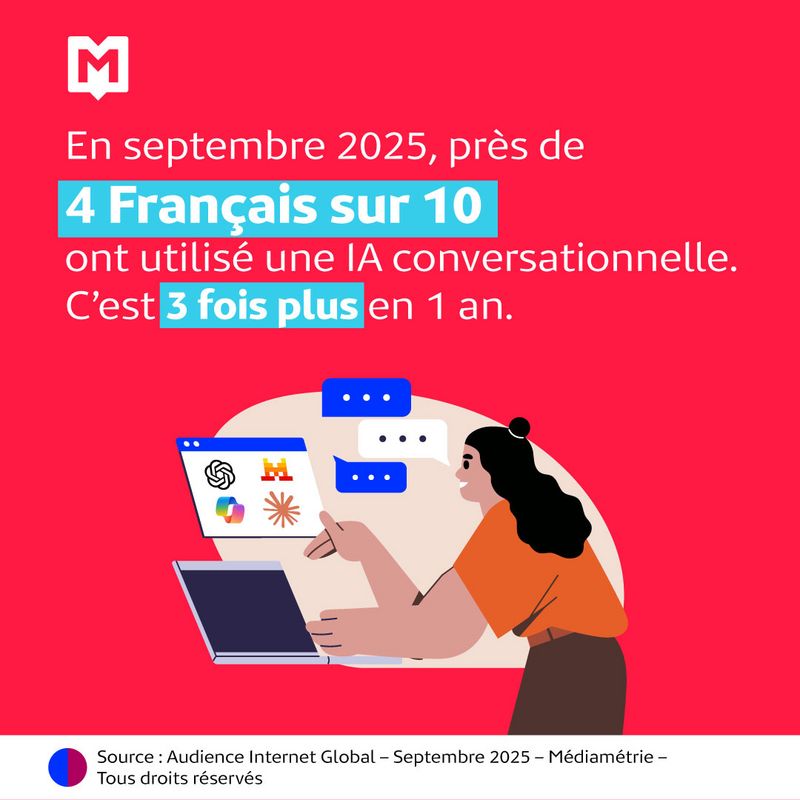
In September 2025, nearly 4 in 10 French people (38.1%)—or 24.5 million people—used a chatbot chatbot Software robot that can interact with an individual or consumer through an automated chat service that can be carried out by choice trees or natural language processing capability. Find out more such as ChatGPT, Google Gemini, or Le Chat, among others[1]. The growth has been spectacular, as their user base has tripled in one year. Consequently, more people are visiting these sites, and they are also spending twice as much time there as they did in September 2024.
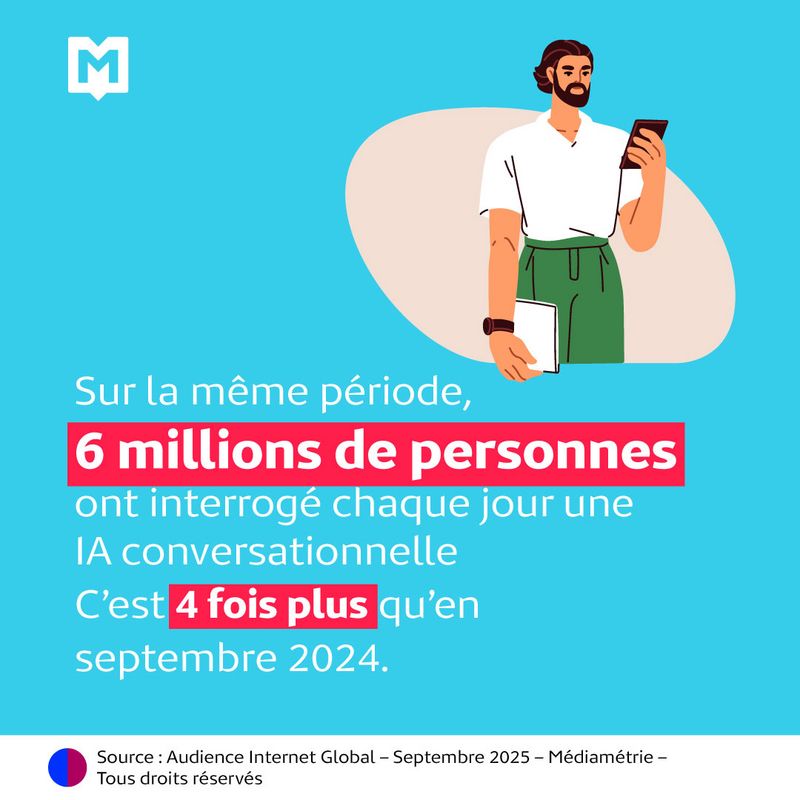
The practice has become part of daily life: 6 million people are asking daily questions of their chatbot chatbot Software robot that can interact with an individual or consumer through an automated chat service that can be carried out by choice trees or natural language processing capability. Find out more in September 2025, four times as many as a year earlier.
While all age groups have embraced them, among 15- to 24-year-olds, the figures are even more striking: nearly three-quarters of them (73.4%) use them every month, and nearly one-quarter (23.3%) do so every day. For this “Generation Z,” seeking information increasingly involves a conversation with an AI agent. Young people are followed by those aged 25–34, more than half of whom (53.9%) had used conversational AI by September 2025[1].
This widespread adoption of AI by young people is linked to their ability to quickly embrace innovations. The promise of a seamless, context-aware interaction appeals to them all the more because it aligns with their digital habits, which are centered on immediacy and personalization.
Young people are not just consumers; they are the driving force behind the spread of these new uses throughout society. Other age groups are following suit: among those aged 25 to 49, about 1 in 2 is a monthly user of conversational AI. Those aged 50–64 have also embraced it, though there is still room for growth: 34.9% of them used conversational AI in September 2025, compared to just 8.5% in September 2024[1] .
How Conversational AI Is Being Used
The dramatic rise of conversational AI sites raises the question of how they are being used.
Internet users primarily use AI tools for educational purposes, to get an explanation of a concept. They then use them in a professional or educational context, and finally to find ideas for places, leisure activities, and outings. They praise their practical, efficient, useful, and high-performing aspects. Non-users, on the other hand, fear that they are “concerning” or even “risky”[2].

A Cultural Shift
This growing interest in conversational AI among young people points to a future where models converge and search engines increasingly incorporate AI. Brands and institutions have caught on: they’re ramping up initiatives to develop their own assistants—such as Ralph Lauren’s “Ask Ralph” for shopping—to stay connected to these new uses.
At the same time, in France, the market is taking shape around major players: OpenAI, with ChatGPT—the first to enter the market—is pulling ahead of the competition with 21.6 million unique visitors in September 2025. It is followed by Google Gemini (2.8 million), Mistral AI with its “Chat” (1.5 million), Perplexity (1.3 million), and Microsoft Copilot (1 million). The rise in power of Mistral, which in 2025 became France’s first “decacorn,” is fueling a national momentum[1] .
What’s next?
The question is therefore no longer whether conversational AI will prevail, but how it will permanently transform the ways we search, learn, and consume. And in this ever-changing landscape, young people are emerging as the driving force, setting a pace of adoption that is pushing all Générations to follow.
Publication Director: Médiamétrie Communications Team
Editor: Laure Osmanian Molinero
[1] Source: Médiamétrie - Mediametrie//NetRatings - Global Internet Audience Audience The set of listeners, viewers, or TV viewers in which each individual is equally weighted, regardless of their listening/viewing duration or frequency of contact. Find out more - France – September 2025 - Sample Sample A subset of the population studied, selected in accordance with a sampling plan, and subject to the collection of information. Find out more : Ages 2 and up - Copyright Mediametrie//NetRatings - All rights reserved
[2] Source: Social Media Observatory – 1st half of 2025 – Sample: Ages 15 and older - Médiamétrie – All rights reserved