
Audio: Digital Consumption Driving Growth
Audio—whether it’s live radio, Podcasts, Streaming musical, audiobooks… —is undergoing a profound transformation, driven by the growth of digital digital A signal is said to be digital if it can be represented by a series of discrete values that can be coded in binary as either 0 or 1. It is the opposite of analogue signal. Digital broadcasting has become the primary mode for television broadcasting, whether by cable, satellite, or even terrestrial. Find out more usage. Far from being merely a technological shift, this evolution is permanently reshaping listening habits and confirms the strength of a medium medium In the broad sense, any means of communication that could convey an advertising message. This is also the name given to various components of a media: TV networks, radio stations, press titles, etc. Find out more that has successfully combined heritage with innovation. At the Innov’Audio Paris 2025 event, the ACPM ACPM ACPM (OJD until 2015) is a professional association which assure diffusion, distribution and counting of newspaper and advertising media. Find out more and Médiamétrie shared key insights into the audio industry.
Radio, a mass medium medium In the broad sense, any means of communication that could convey an advertising message. This is also the name given to various components of a media: TV networks, radio stations, press titles, etc. Find out more , has fully entered the digital digital A signal is said to be digital if it can be represented by a series of discrete values that can be coded in binary as either 0 or 1. It is the opposite of analogue signal. Digital broadcasting has become the primary mode for television broadcasting, whether by cable, satellite, or even terrestrial. Find out more age
First key statistic: Radio remains an indispensable mass medium, listened to daily by nearly 38 million French people[i]. This power is now also evident in the digital realm.


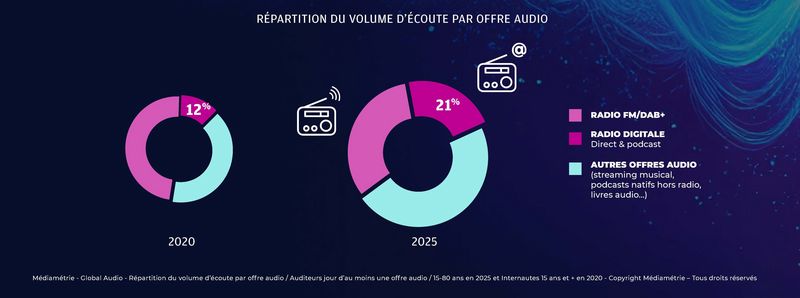
In 2025, 21% of total audio listening will come from digital digital A signal is said to be digital if it can be represented by a series of discrete values that can be coded in binary as either 0 or 1. It is the opposite of analogue signal. Digital broadcasting has become the primary mode for television broadcasting, whether by cable, satellite, or even terrestrial. Find out more radio—whether live or via Podcasts—compared to 12% in 2020. In five years, this share has therefore nearly doubled[ii].
This growth is also reflected in listening time. Live digital digital A signal is said to be digital if it can be represented by a series of discrete values that can be coded in binary as either 0 or 1. It is the opposite of analogue signal. Digital broadcasting has become the primary mode for television broadcasting, whether by cable, satellite, or even terrestrial. Find out more radio now accounts for 1.3 million hours of daily listening, up 19% from 2020, with an average average The average is one of the most important statistical indicators for a set of numbers. By default, it is the arithmetic mean, calculated by adding the values in the set and then dividing that sum by the number of values. Find out more daily listening time of 41 minutes, representing nearly two additional minutes over the past five years. This is a strong indication of how firmly the practice has taken root[iii].
Now, one-quarter of total radio consumption takes place on digital media. While the 35–49 age group remains the largest contributor (33% of their radio listening takes place digitally), growth is now driven by those over 50, confirming widespread adoption across all generations.[iv]. The smartphone has established itself as the leading medium for digital listening, accounting for nearly two-thirds of usage, while smart speakers continue to gain power[v].
Podcasts: The Essence of the Audio Revolution
It is in the world of podcasts that this transformation is most clearly evident.
Over the past five years, the number of Podcast Podcast Audio programme in the form of episodes or series available online for listening on demand. This terminology comes from the contraction of the words Ipod and Broadcast... Find out more listeners has grown by 76%, with momentum remaining very strong: +16% in just two years[vi].
This massive adoption is accompanied by impressive volumes. In October 2025, Radio catch-up catch-up Catch-up technology allows TV viewers to watch or rewatch a television programme after it has been broadcast live. Find out more podcasts totaled 5.6 million daily downloads worldwide[vii]. Added to this are nearly 900,000 native Podcasts (excluding catch-up radio ) downloaded daily[viii], illustrating the complementary nature of live broadcasts and on-demand listening.
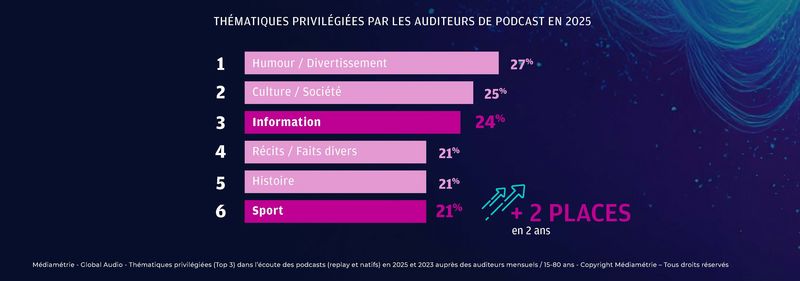
Podcasts appeal to listeners because of their editorial flexibility. Listeners favor humor and entertainment, followed by cultural and social topics. News remains consistently in the top 3 favorite topics, while sports have seen spectacular growth, climbing two spots in two years to join news and history programs[ix].
This ability to cover both breaking news and in-depth topics is reflected in usage patterns: In 2025, downloads of sports Podcasts in France increased by 26% between the first and second quarters, driven by major sporting events such as Paris Saint-Germain’s victory in the Champions League and the French Open. We also see dramatic spikes during major events, such as the Tour de France (+123% in July vs. June 2025)[x].
The formats themselves reflect this maturity: 38% of downloads are for Podcasts lasting 15 to 30 minutes, 29% are long-form episodes lasting more than 30 minutes, and 33% are short-form episodes, proving that no single length dominates and that there is a place for every use case[xi].
Finally, Podcasts continue their geographic and social expansion. While Upper SPG categories Upper SPG categories This term describes business owners, artisans and merchants, executives, upper-level intellectual professions and intermediate professions. Find out more and Parisian listeners remain highly engaged, monthly listening is growing strongly among lower SPG categories SPG categories The SPG (socio-professional category), was replaced in 1982 by the classification of Professions and Socio-professional Categories (PCS), a nomenclature defined by France’s INSEE, which classifies the population according to a combination of profession (or former profession), hierarchical position and status (employee or otherwise). Find out more , the non-working population non-working population According to convention, this category includes those who are neither employed nor unemployed: young people aged under 15 years old, students and pensioners who do not work in addition to their studies or retirement, housewives, people who are incapable of working, etc. Find out more , and in small agglomerations (up to +25% in two years)[vi]. This trend is accompanied by significant investment from regional media: more than 160 Podcasts from regional press outlets are now included in the ACPM ACPM ACPM (OJD until 2015) is a professional association which assure diffusion, distribution and counting of newspaper and advertising media. Find out more rankings[xi].
Complementary uses throughout the day
Live radio, Streaming musical, Podcasts: audio doesn’t operate in silos, but rather in a complementary manner. Live radio remains the go-to morning choice, accounting for the largest share of total daily audio listening between 6 a.m. and 9 a.m., while on-demand offerings—particularly music Streaming Streaming A technical method of digitally transmitting data to enable the playback of a continuous flow of video and audio material. Unlike terrestrial or satellite TV broadcasting, this technology requires a two-way network (internet) to send periodic requests to the streaming server in order to receive video or audio micro-files. Find out more —gradually take over in the afternoon[ii]. This temporal pattern allows audio to be part of every moment of life.
A medium medium In the broad sense, any means of communication that could convey an advertising message. This is also the name given to various components of a media: TV networks, radio stations, press titles, etc. Find out more already geared toward the next generations
Finally, audio confirms its ability to reach reach Reach is the term used to describe the reach achieved by a medium, publication, advertisement or campaign. It corresponds to the number of users reached and is therefore quantitative data. Reach plays a key role in measuring return on investment. It is used to determine whether or not the communication is effective. Whether for a website or a social network, reach corresponds to the proportion of the Internet user population or the audience reached by the site or network over a set period. Find out more all audiences, including the youngest. 15- to 24-year-olds use audio more intensively in the evenings[ii], and the selection of native Podcasts for children is experiencing remarkable growth, with 17.6 million downloads worldwide in the first nine months of 2025, driven by recognizable brands and a strong Correlation with school vacation periods[xii].
Published by: Médiamétrie Communications Team
Written by: Laure Osmanian Molinero
[i] Médiamétrie – EAR > National, November–December 2025, Cumulative audience audience The set of listeners, viewers, or TV viewers in which each individual is equally weighted, regardless of their listening/viewing duration or frequency of contact. Find out more , ages 13 and older, Monday–Friday, 5 a.m.–midnight
[ii] Médiamétrie - Global Audio - Distribution of listening volume by audio service / Listener Listener Someone who is listening to a radio station, an aggregate of stations or a coordination; this generic term can also be used for television (however, its preferred term is "TV viewer"). Find out more count for at least one audio service / Ages 15–80 in 2025 and Internet users aged 15 and older in 2020
[iii] ACPM ACPM ACPM (OJD until 2015) is a professional association which assure diffusion, distribution and counting of newspaper and advertising media. Find out more - Radio Certification - Calculation of growth on a constant global basis: first 9 months of 2025 vs. 2020
[iv] Médiamétrie – EAR > Global Radio, January–March 2020 to 2025, [v] ACPM - Radio Certification - Active Listening Sessions Worldwide - Calculation of year-over-year growth on a like-for-like basis: first 9 months of 2025 vs. 2022
[vi] Médiamétrie - Global Audio - Monthly Reach Reach Reach is the term used to describe the reach achieved by a medium, publication, advertisement or campaign. It corresponds to the number of users reached and is therefore quantitative data. Reach plays a key role in measuring return on investment. It is used to determine whether or not the communication is effective. Whether for a website or a social network, reach corresponds to the proportion of the Internet user population or the audience reached by the site or network over a set period. Find out more of Radio and Native Podcasts / Ages 15–80 in 2023/2025 and Internet Users Ages 15 and Older in 2020
[vii] Médiamétrie – EAR > Podcast Podcast Audio programme in the form of episodes or series available online for listening on demand. This terminology comes from the contraction of the words Ipod and Broadcast... Find out more – Global Podcast Downloads from Radio Publishers in the Médiamétrie Rankings / October 2025 - Copyright Médiamétrie - All rights reserved
[viii] ACPM - Podcast - October 2025 - Global Downloads.
[ix] Médiamétrie - Global Audio - Top 3 topics in podcast listening (Catch-up and native podcasts) in 2025 and 2023 among monthly listeners / ages 15–80
[x] ACPM - Podcast - Downloads in France - Sports Category - Jan 2025 - Sept 2025
[xi] ACPM - Podcast - Global Downloads Q1–Q3 2025
[xii] ACPM - Podcast - Global Downloads on a Like-for-Like Basis Jan 2024 – Sept 2025