
Milan-Cortina 2026: A record-breaking Games for the French Team… and for the audience

In this edition, Isabelle Maurice, Director of Studies, Monitoring, and Forecasting, and Valentine de Planta, Senior Research Analyst, share their analysis of the Milan-Cortina Winter Olympics: broadcaster performance, the most-watched sports, and viewing habits during the Games. For two weeks, the competitions drew viewers to a wide range of channels and platforms.
Put on your headphones… and enjoy the listen!
And to go further :

From February 6 to 22, 2026, the Milan-Cortina Winter Olympics demonstrated the ability of major sporting events to bring together a wide audience. Thanks to the absence of a time difference, the athletes’ exceptional performances, and extensive media coverage, the Games attracted 55.3 million French viewers. Beyond the television viewership figures, this edition also illustrates the evolution of audience measurement: home internet screens and out-of-home consumption now fully contribute to the scale of the phenomenon.
Record-breaking coverage for the Winter Games
With 55.3 million French people in contact with the Games, the Milan-Cortina edition has achieved unprecedented reach for a Winter Olympics.
Isabelle Maurice, Director of Studies, Monitoring, and Forecasting at Médiamétrie, confirms:
“These Olympic Games were a major television event. This edition had several advantages: no time difference and sports in which the French excel. As a result, television coverage was particularly extensive.”
This performance can be partly attributed to the circumstances: unlike the 2022 Beijing Games, the absence of a time difference allowed the competitions to be broadcast during time slots that were particularly convenient for French viewers.
Viewership for the Games was largely driven by the exceptional performances of French athletes. With 23 medals won, France set a historic record for the Winter Olympics.
In total, 20 French athletes stood on the podium across 7 different disciplines, helping to ensure a continuous French presence throughout the two-week event and strengthening viewers’ engagement with the competitions.
In this context, the editorial coverage also played a key role. The Games received extensive daily coverage, with over 15 hours of live broadcast per day on France Télévisions Group channels and all sessions on the digital channel France TV Sport. 865 hours of competition were broadcast on the two Eurosport channels as well as on Eurosport.fr, the Eurosport app, and HBO Max, which covered the entire competition, providing continuous visibility for the various disciplines.
Out-of-home and online screens: a wider audience
One of the key features of this edition is the expansion of the audience measurement scope.
The results now include:
- home internet screens,
- households without a television,
- and out-of-home viewing.
These developments show that the audience for major events is now part of a hybrid consumption ecosystem, combining television, streaming, and group viewing outside the home.
On average, 1.1 million viewers engaged with the competition outside their homes each day.
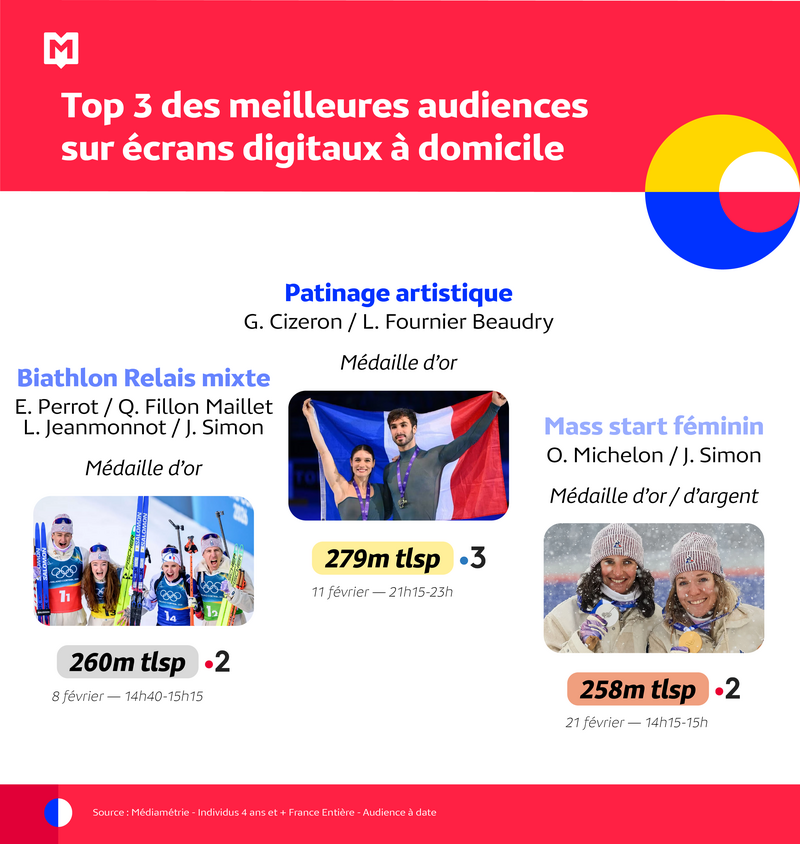
Biathlon and Nordic skiing dominate the ratings
“Unsurprisingly, biathlon has emerged as the most popular sport of these Games, given the number of medals won in this discipline.”
explains Valentine de Planta, senior research analyst at Médiamétrie.
The highest viewership was recorded for the spectacular biathlon mass start, highlighted by the double victory of Océane Michelon and Julia Simon, which drew 5.5 million viewers and a 46.3% audience share on February 21st on France 2.
Several other competitions also drew over 4 million viewers, including:
- the biathlon mixed relay,
- figure skating,
- and certain cross-country skiing events
These sports accounted for a large portion of the competition’s highest viewership figures.
An event that always shapes the television landscape
Non-competition programming highlights also contributed significantly to the Games’ overall performance. The opening ceremony drew 6.1 million viewers and achieved a 36.1% audience share, while the closing ceremony attracted 4.8 million viewers (25.9% audience share), confirming their role as unifying moments capable of reaching a wider audience than the sporting events alone.
Aired daily between 11 p.m. and midnight, the “JO Club” magazine show also established itself as a recognizable appointment during the 15 days of the Olympics, with an average of 1.4 million viewers, helping to maintain audience enthusiasm for the Games and build viewer loyalty.
The Milan-Cortina Games demonstrate the continuing ability of major sporting events to unite a massive audience around national champions in a fragmented media landscape.
The success of Milan-Cortina rests on the synergy between linear broadcasting on major channels, the expansion to digital screens, and the contribution of the out-of-home audience, which reinforces the event’s collective dimension.
In a context where media consumption is diversifying, the Olympic Games thus confirm their status as a major audiovisual event, capable of bringing together tens of millions of French people, regardless of the screen or viewing location.
Publication management: Médiamétrie Communications Team
Editor: Laure Osmanian Molinero
Source: Médiamétrie - Individuals aged 4 and older, France-wide – Cumulative audience
des médias
edition
definitions